Quick answer: Sermorelin and tesamorelin are both analogs of growth-hormone-releasing hormone, and that is where the match ends. Tesamorelin is a currently approved prescription drug with one narrow labelled use. Sermorelin's brand, Geref, lost its FDA approval in 2009 after the maker discontinued it, and today's sermorelin is a compounded product that is not FDA-approved. Their evidence is different, too.
Readers meet these two names together because both come from the same family of peptides and both turn up in clinic menus and forum threads. This page puts them side by side using FDA documents, the tesamorelin label and published abstracts. It does not pick one for you. For the single-peptide background, see the sermorelin profile and the tesamorelin profile.
The two side by side
| Question | Sermorelin | Tesamorelin | Source |
|---|---|---|---|
| Class | 29-amino-acid analogue of human growth-hormone-releasing hormone | Growth hormone-releasing factor (GHRF) analog built on the 44-amino-acid human sequence | Prakash and Goa 1999; Egrifta SV label |
| Brand history | Geref: ampule approved 1990, vials approved 1997; approval withdrawn effective 2009-06-18 | Egrifta: initial U.S. approval 2010, still marketed | Federal Register 2013-03-04; Egrifta label |
| Approved use | Geref was approved for children with growth failure from idiopathic growth hormone deficiency, and as a diagnostic ampule | Adults with HIV and lipodystrophy who have excess abdominal fat | Federal Register notice; Egrifta label |
| FDA compounding lists | 503B Category 1 (marked as a component of an approved drug); on no 503A list | Not named in the 503B file or the 503A lists we read | 503B list; 503A list |
| Human evidence | Studies of GHRH-(1-29) peptides in older adults, children and men; small, mostly short | Two 26-week placebo-controlled trials in the labelled population | PubMed abstracts; Egrifta label |
| WADA prohibited list 2026 | Named under S2 | Named under S2 | WADA 2026 list |
| Whoosh offers this | Yes, compounded, as stated by Whoosh | No | Whoosh product page |
As of 2026-10-06. FDA's 503B file is dated March 21, 2025; we did not find a newer one.
How each one works
Both peptides imitate the hormone the hypothalamus uses to tell the pituitary gland to release growth hormone. They differ in construction. Sermorelin, per the Prakash and Goa review, is the first 29 amino acids of that hormone. Tesamorelin, per its label, carries the full 44-amino-acid human sequence plus a hexenoyl group at one end.
The label also reports tesamorelin's clearance speed: 8 minutes for the mean elimination half-life, measured in healthy volunteers after one injection. For sermorelin, none of the sources we opened gave a half-life, and the Geref label could not be retrieved, so we state none. Anyone quoting a half-life for sermorelin should show where it comes from.
FDA status and history
Sermorelin. The Federal Register notice of March 4, 2013 records two Geref applications held by EMD Serono: the ampule, initially approved December 28, 1990, and the vials, initially approved September 26, 1997. The maker told FDA in 2008 it was discontinuing both and asked for the applications to be withdrawn, and FDA announced it was withdrawing approval effective June 18, 2009. In 2013 FDA ruled that neither Geref product left the market over safety or effectiveness concerns. The ruling is procedural, since it allows generic applications to be considered, and it does not vouch for today's compounded products. The is sermorelin FDA-approved page walks through the timeline.
Compounded sermorelin is not FDA-approved. On FDA's 503B file for outsourcing facilities, sermorelin acetate is listed in Category 1, bulk substances under evaluation, with a mark showing it is a component of an FDA-approved drug. Category 1 is not an approval.
Tesamorelin. Egrifta carries the approval and a full label. Because it is a marketed approved product, a manufacturer's label, trials and a postmarketing record sit behind every statement. Sermorelin has no label in force today.
What human evidence exists
For sermorelin, the adult studies in the literature used peptides described as GHRH-(1-29) or an analog of it, so the abstracts do not always say "sermorelin." Examples:
- A 5-month study in 10 women and 9 men aged 55 to 71 used [Nle27]GHRH-(1-29)-NH2, a GHRH analog. Overnight growth hormone rose in both sexes, body weight was unaffected, and lean body mass rose in men only. (Khorram 1997.)
- A 6-week study, with no placebo arm stated in its abstract, in 11 healthy men aged 64 to 76 used GHRH(1-29). Nighttime growth hormone rose, but IGF-I did not change and DEXA measures of fat and muscle did not change. Two of six strength measures improved. (Vittone 1997.)
- A pediatric study by the Geref International Study Group followed 110 previously untreated prepubertal children with growth hormone deficiency; the abstract reports that 86 were eligible for efficacy analysis and that average height velocity roughly doubled at six months.
For tesamorelin, the label describes two randomized, placebo-controlled studies, one of 412 and one of 404 HIV-infected adults with lipodystrophy and excess abdominal fat. Both ran 26 weeks, and visceral fat fell more than with placebo. Those results belong only to that population.
| Claim as marketed | Who says it | What supports it | Grade |
|---|---|---|---|
| Tesamorelin reduces abdominal fat | The Egrifta label, for one population | Two label trials in HIV-infected adults with lipodystrophy | APPROVED LABEL |
| Tesamorelin works for general weight loss | Some online sellers of research products | The label states it is not indicated for weight loss management | NO PUBLISHED DATA |
| Sermorelin supports lean body composition | Whoosh product page, as stated by Whoosh | Lean mass rose in men only in one 16-week study of a GHRH analog; no change in another small study | STUDIED IN HUMANS |
| Sermorelin has a well-established clinical history | Whoosh pricing page, as stated by Whoosh | Geref approved for children's growth failure, then withdrawn in 2009 | STUDIED IN HUMANS |
| Sermorelin and tesamorelin are interchangeable | Marketing copy on peptide sites | No source we read compares them head to head | NO PUBLISHED DATA |
| Tesamorelin sold as a "research" product is equivalent to Egrifta | Online peptide vendors | FDA warning letters call such products unapproved new drugs | NO PUBLISHED DATA |
Safety statements as the sources report them
Tesamorelin (label). Its contraindications, per the label, cover pituitary-axis disruption, active malignancy, known hypersensitivity and pregnancy. The warnings section also flags higher mortality in acute critical illness, among other items. The label says long-term cardiovascular safety has not been established.
Sermorelin (literature). Prakash and Goa report transient facial flushing and pain at the injection site as the most commonly reported adverse events in children. Khorram reported transient raised blood fats; Vittone reported no significant adverse effects. These are small, short studies, and they are not a label. FDA's safety-risks page does not name sermorelin.
Neither set of statements transfers to the other peptide.
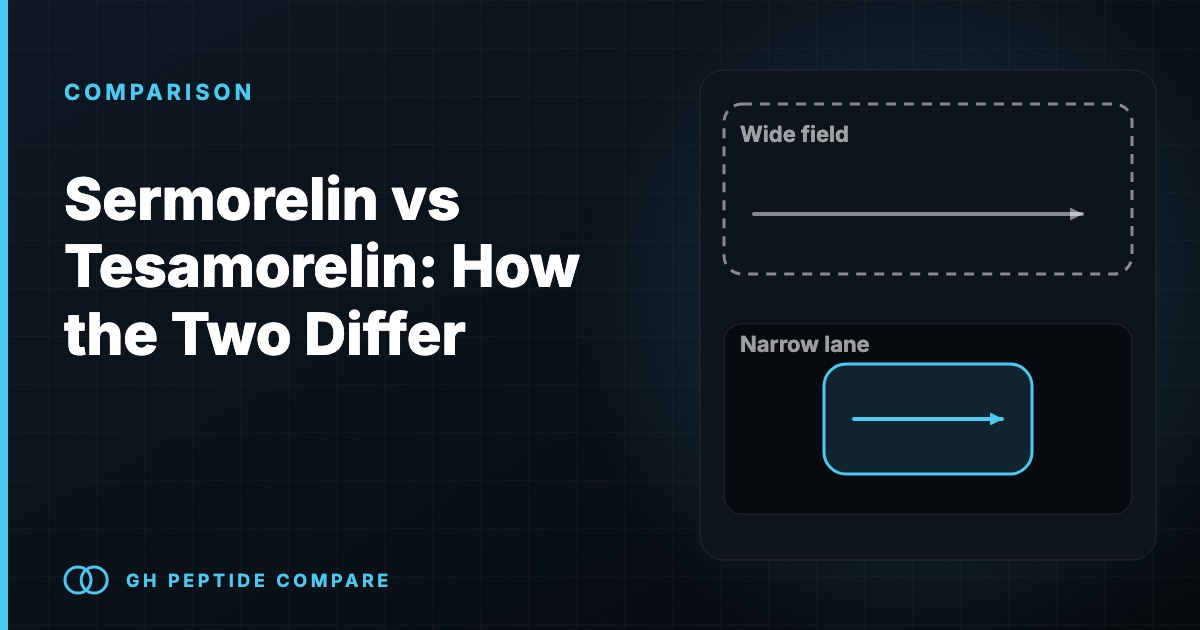
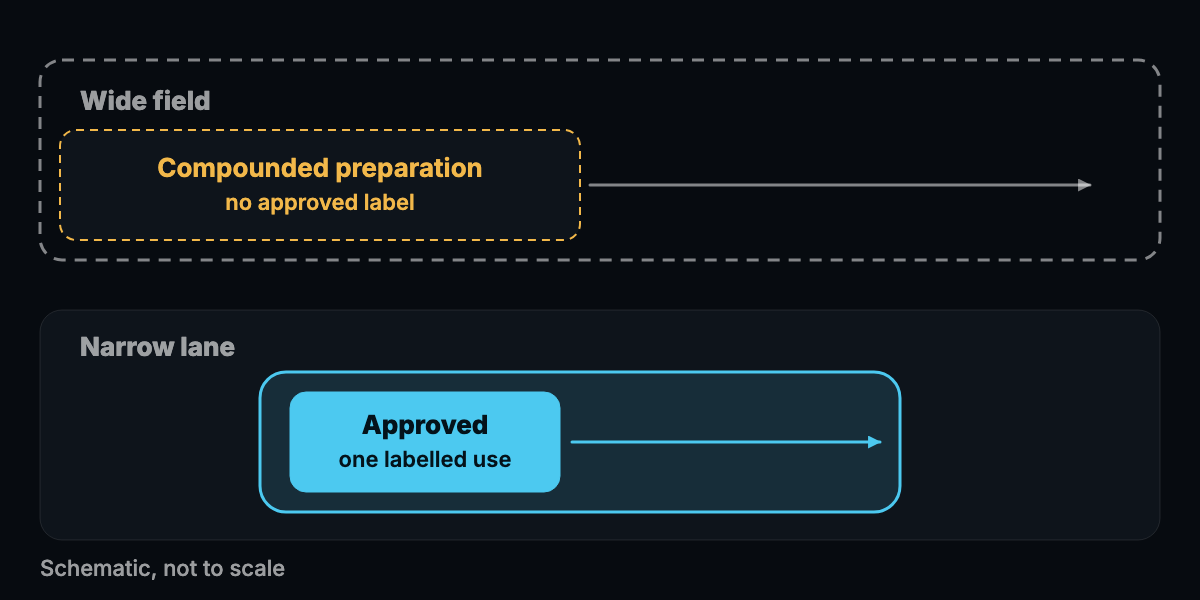
Same receptor, one narrow label
Sharing a target does not mean sharing a regulatory position. A drug's approval is attached to one use in one group of people, backed by trials in that group. Tesamorelin's approval reaches only HIV-infected adult patients with lipodystrophy. It was never granted for healthy adults, for people seeking a lower scale weight, or for aging, and the label rules out weight loss management outright.
That narrowness cuts two ways. A reader who sees "FDA-approved tesamorelin" on a clinic page should check whether the claim made matches the label's one use. A reader who sees "same family as an approved drug" next to sermorelin should note that the approved drug's trial results were measured in a different population with a different peptide.
Sermorelin's own approvals were narrow, too. Geref was approved for diagnostic testing of pituitary reserve and for children with idiopathic growth hormone deficiency. The Geref International Study Group's pediatric results do not describe adults. The approval history of one peptide, then, tells you little about what a clinic offers for adults today, which is a compounded product with no approval of its own.
Neither peptide carries an FDA-reviewed claim for muscle gain or weight loss in healthy people. WADA's 2026 Prohibited List names both in class S2, which tells readers only that anti-doping rules cover them.
Who offers what
Whoosh offers compounded sermorelin and does not offer tesamorelin, ipamorelin, CJC-1295 or MK-677, as stated by Whoosh, read 2026-10-06. Compounded medications are not FDA-approved, and Whoosh's own terms say they are not reviewed by FDA for safety or efficacy. A licensed physician decides whether a prescription is appropriate. Whoosh's own pages disagree on how fast a physician reviews an intake, so read the Whoosh Wellness sermorelin review for what it states and where its pages differ. Tesamorelin is available only as the approved branded drug, through a prescriber.
Which question are you asking?
| Situation | What the sources say | Page to read |
|---|---|---|
| I want to know which is FDA-approved today | Tesamorelin has a current label; Geref's approval was withdrawn in 2009 | Is sermorelin FDA-approved |
| I saw both on a clinic menu | Different regulatory positions; only one is an approved product | Three-way table |
| I want to know what the tesamorelin trials covered | HIV-infected adults with lipodystrophy and excess abdominal fat | Tesamorelin profile |
| I want to know what sermorelin studies measured | GH-axis markers and small body-composition outcomes, in specific groups | Sermorelin profile |
| I want to compare with CJC-1295 | Structure and half-life differ; FDA raised its own safety statements | Sermorelin vs CJC-1295 |
| I want to compare with a ghrelin-receptor peptide | A different receptor and a never-approved drug | Ipamorelin vs tesamorelin |
FAQ
Do sermorelin and tesamorelin work the same way?
Both imitate the hormone that signals growth hormone release. They differ in length and structure, and sources describe different clearance and different evidence.
Is tesamorelin a more potent sermorelin, as some sites say?
No source we read says so. Tesamorelin is a longer, modified molecule with its own label, and no head-to-head study appeared in our searches.
Can compounded sermorelin be used for what tesamorelin is approved for?
The sources do not say. Egrifta's label covers HIV-associated lipodystrophy only, and compounded sermorelin is not FDA-approved for any use.
Why does a 2013 FDA notice say Geref was not withdrawn for safety?
It records a determination that lets generic applications be considered. It says nothing about today's compounded products.
Are both on the anti-doping list?
Yes, WADA's 2026 Prohibited List names both under S2.
Does Whoosh offer tesamorelin?
No. As stated by Whoosh, read 2026-10-06, it offers compounded sermorelin among its products and not tesamorelin.
Sources
- Federal Register 78 FR 14095, 2013-03-04 read 2026-10-06
- EGRIFTA SV label, DailyMed read 2026-10-06
- FDA 503B category list, March 21, 2025 read 2026-10-06
- FDA 503A category list, May 14, 2026 read 2026-10-06
- Khorram et al. 1997, PubMed 9141536 read 2026-10-06
- Vittone et al. 1997, PubMed 9005976 read 2026-10-06
- Thorner et al. 1996, PubMed 8772599 read 2026-10-06
- Prakash and Goa 1999, PubMed 18031173 read 2026-10-06
- WADA 2026 Prohibited List read 2026-10-06
- Whoosh Wellness terms and conditions read 2026-10-06
Not medical advice. See the medical disclaimer.