Quick answer: A prescriber sets sermorelin dosing, and this page prints no dose figures and no schedules on purpose. Published figures differ because they come from different groups of people, such as children, healthy older adults or diagnostic testing, and from different products. The brand, Geref, once had a label for children with growth failure and for a diagnostic test. Compounded sermorelin is not FDA-approved and has no label of its own.
If you searched for a sermorelin dosage chart, you will not find one here, and the reason is not caution for its own sake. A number copied from one source and applied to another situation can be wrong in ways the number itself does not reveal. What this page offers instead is an explanation of why the figures disagree, what the historical label population was, and a set of questions to bring to a licensed clinician. For the basics of the peptide itself, start with the sermorelin profile.
A note on disclosure: some links on this page are affiliate links to Whoosh Wellness, and we may earn a commission if a reader uses them. The explanation that follows would be the same without them.
Why a prescriber sets the dose
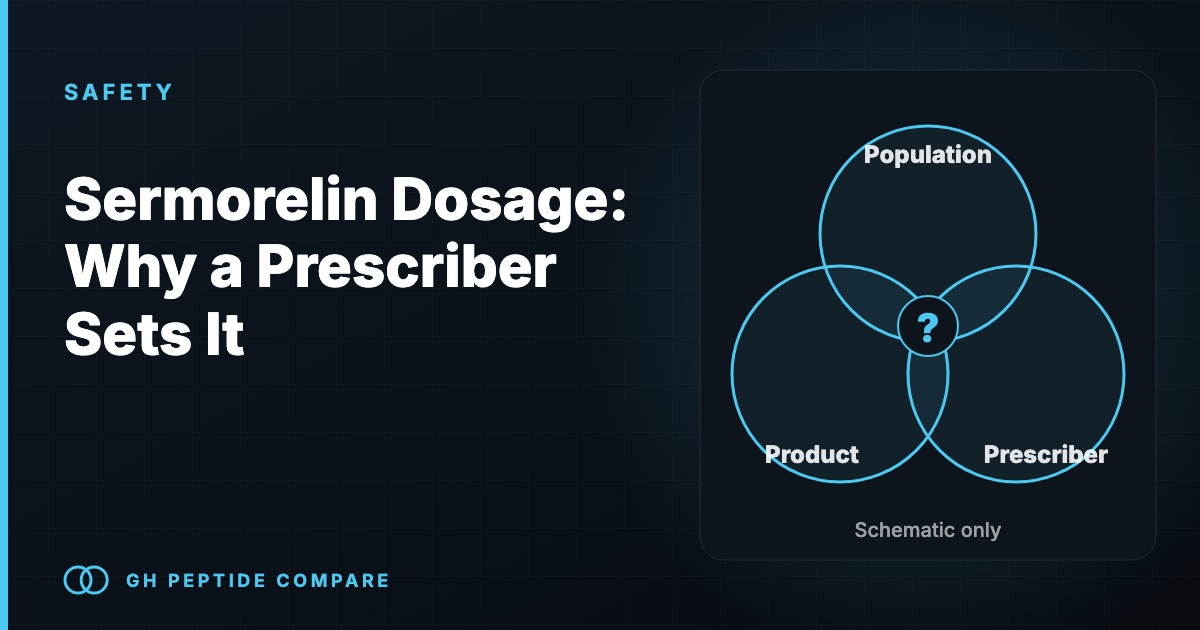
A dose is not a property of a molecule. It is a decision about a particular person, a particular product and a goal, made with information that a web page does not have. Several of those inputs are worth naming.
Who the person is. Age, body size, kidney and liver function, other medications, and existing conditions all bear on how much of a drug is reasonable. A clinician knows these. A web page does not.
What the goal is. In the published literature, sermorelin-type peptides were used for different purposes: stimulating growth in children with a diagnosed deficiency, testing whether a pituitary gland can respond, and, in research settings, studying hormone levels in older adults. Each purpose carries its own approach.
What the product is. A manufactured, approved product has a defined strength and a label. A compounded preparation is made by a pharmacy and is not FDA-approved, so its strength and presentation depend on that pharmacy and on what the prescriber specifies.
What is monitored. Dose is rarely a single decision. With growth-hormone-axis drugs, prescribers look at the person's response over time and adjust. The Endocrine Society's guideline on adult growth hormone deficiency, which concerns recombinant growth hormone and not sermorelin, says confirmation through stimulation testing is usually required, which is one example of how much clinical work happens before a regimen is chosen.
Whoosh Wellness states on its pages that a licensed physician reviews each intake individually, and says its monthly check-ins keep that physician involved and allow dosing to be adjusted. Those are Whoosh's statements, read 2026-10-06. We do not repeat the figures on its blog pages, and the next section explains one reason.
What the old brand label covered, in words
Geref, the brand name for sermorelin acetate, was approved in two forms. According to the 2013 Federal Register notice, the first was an ampule approved in 1990 for evaluating the ability of the pituitary gland to secrete growth hormone, which is a diagnostic use. The second was vials approved in 1997 for children with idiopathic growth hormone deficiency and growth failure.
The same December 2024 FDA briefing, quoting the old pediatric label, says a child who responds poorly to a stimulation test was not a candidate for Geref. The population the product was approved for was narrow, and no adult dose came with it.
So the population on the old label was children with a diagnosed deficiency, plus a diagnostic test. It was not healthy adults looking for wellness benefits. We could not open the label itself, because FDA's database lists it as unavailable and a DailyMed search found nothing, so we do not quote its dosing section. The relevant history is in the FDA timeline.
For a pediatric review, Prakash and Goa wrote in BioDrugs in 1999 that the effects of the recommended sermorelin regimen had not been directly compared with those of somatropin, the recombinant growth hormone. That is a statement about children and says nothing about adults.
Why a compounded product has no label to follow
A label exists because a company filed an application and FDA reviewed it. A compounded medication goes through no such review, and Whoosh's own terms say compounded medications are not reviewed or approved by the FDA for safety or efficacy. On the outsourcing-facility (503B) list that FDA updated in March 2025, sermorelin acetate sits in Category 1 with a note tying it to a previously approved drug. That is a compounding-policy category and not an approval, and it supplies no label.
The practical effect is that no regulator-reviewed document tells you what amount to expect from a compounded preparation. You rely on the pharmacy's documentation and your prescriber's judgment. This is why the questions checklist asks which pharmacy prepares the product and what testing exists, and why one useful question is simply how the strength is expressed on the paperwork you receive.
Why two sources can both be right and different
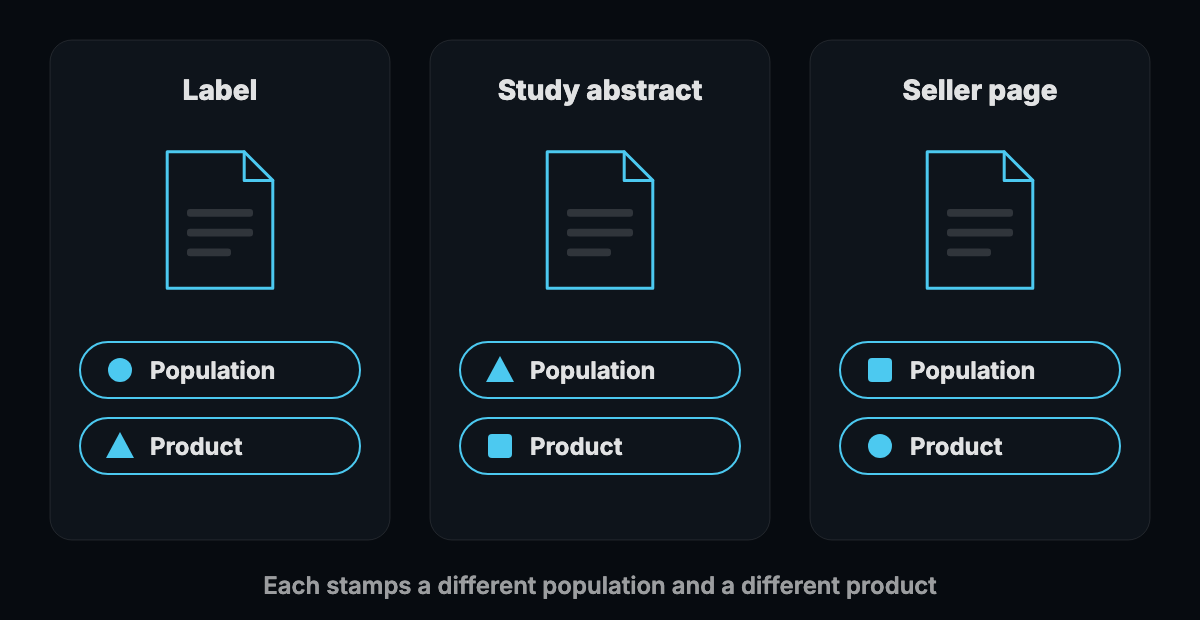
This is the section most dosage pages skip. Suppose you find one source that gives an amount and another that gives a very different amount for the same word, sermorelin. Neither needs to be mistaken. The sources may be describing different people, different products or different purposes, and each can be accurate for its own situation.
| Source type | Who it describes | Product it describes | Why its figure would differ from the others |
|---|---|---|---|
| Pediatric trial (Thorner and colleagues, 1996, 110 children) | Previously untreated prepubertal children with growth hormone deficiency | A GHRH-(1-29) peptide in a research setting | Children's regimens are tied to body size, and the goal was growth |
| Diagnostic ampule on the old label | People undergoing a pituitary function test | A single-use diagnostic product given by a clinician | A test is meant to produce a measurable response once, not to be used over time |
| Studies in healthy older adults (Khorram, Vittone, Corpas) | Healthy men, and in one study women, aged 55 and older | A GHRH-(1-29) peptide or analog, with different preparations across studies | Different preparations, different amounts, different durations, small groups; the authors of one study wrote that how the peptide is given affects how well it works |
| Retrospective chart review (Sigalos and colleagues, 2017) | 14 men on testosterone | A combination of three peptides | A mix is not the same as one peptide, and a chart review has no control group |
| Seller blog posts | Adult wellness customers | Compounded products | Two Whoosh blog posts we read give ranges that do not match each other, as stated by Whoosh, read 2026-10-06 |
Read down the last column and a pattern appears. Each source answers a different question. A figure from a children's growth study is not wrong because it differs from a seller's range. It was never describing the same thing.
Three further reasons explain why figures differ even within one population.
First, the peptide differs between studies. The adult abstracts describe a GHRH-(1-29) peptide or analog, and the abstracts do not all name sermorelin. A different molecule or salt form changes what a given amount means.
Second, the outcome differs. A study aiming to raise a hormone level and a study aiming to measure strength use different designs, and neither is the same as a clinician aiming for a particular response in a particular person.
Third, the way the product is given differs. Studies in this area differed in how long the peptide was given and in who was studied, which is one reason their results do not carry over to a person today. We do not describe the research regimens, because they were designed for research, not as guidance.
The upshot is the opposite of a chart. Two documents giving unlike figures should make you ask what population and product each one means, not which is correct.
What to ask a prescriber about dosing
These questions come from the above and are consistent with the checklist.
- Is the product I am being offered an approved drug or a compounded preparation, and who prepares it?
- How is the strength written on the paperwork, and does it match what was prescribed?
- What is the goal, and how will we tell whether it is being met?
- Which tests or check-ins come before and during use?
- What would cause you to change the amount, pause or stop?
- What should I do if I notice a reaction? The side effects page lists what sources report.
- Who do I contact between visits?
Whoosh states that completing its intake does not guarantee a prescription and that medical decisions are made by licensed providers. Whoosh's terms say its compounded medications are not FDA-approved.
Where a prescriber fits
Dosing is the clearest example of why this decision belongs with a clinician. A licensed physician decides whether a prescription is appropriate, and that physician is the right person to answer the questions above. If you want to see what Whoosh's intake asks, the button below goes there. No approval is promised: a licensed physician decides whether a prescription is appropriate, and the button is not advice to use any product.
Sources
- Federal Register: GEREF determination notice, 2013-03-04 read 2026-10-06
- FDA Pharmacy Compounding Advisory Committee briefing document, 2024-12-04 read 2026-10-06
- Drugs@FDA: Geref application 020443 read 2026-10-06
- FDA: 503B bulk drug substances categories list, updated 2025-03-21 read 2026-10-06
- PubMed: Thorner et al., Geref International Study Group, 1996 read 2026-10-06
- PubMed: Prakash and Goa, BioDrugs 1999 read 2026-10-06
- PubMed: Khorram, Laughlin and Yen, 1997 read 2026-10-06
- PubMed: Vittone et al., 1997 read 2026-10-06
- PubMed: Corpas et al., 1992 read 2026-10-06
- PubMed: Sigalos et al., 2017 read 2026-10-06
- PubMed: Molitch et al., Endocrine Society guideline, 2011 read 2026-10-06
- Whoosh Wellness: terms and conditions read 2026-10-06
- Whoosh Wellness: how it works read 2026-10-06
FAQ
What is the right sermorelin dose?
There is no single figure, and this page does not print one. A prescriber sets dosing for a particular person and product. Published figures describe different groups, such as children with growth failure or healthy older adults in research.
Why do websites give such different numbers?
They describe different populations, products and purposes, and some are seller marketing. Even two blog posts from the same seller give ranges that do not match, as stated by Whoosh, read 2026-10-06.
Did the old Geref label list a dose?
An approved label does, but we could not open the Geref label and FDA's database lists it as unavailable, so we quote none. We can say it covered children with growth failure and a diagnostic test.
Does compounded sermorelin follow a label?
No. Compounded sermorelin is not FDA-approved and has no label of its own. The strength and presentation depend on the pharmacy and the prescription.
Can I work out a dose from a study?
No. The studies used research preparations in small groups, some of them GHRH-(1-29) analogs, and were not written as guidance. Bring the study to a prescriber instead.
What should I ask about dosing?
Ask what the product is, how its strength is written, how response will be measured, what would change the plan and who to contact. The checklist has the full list.
Not medical advice. See the medical disclaimer.