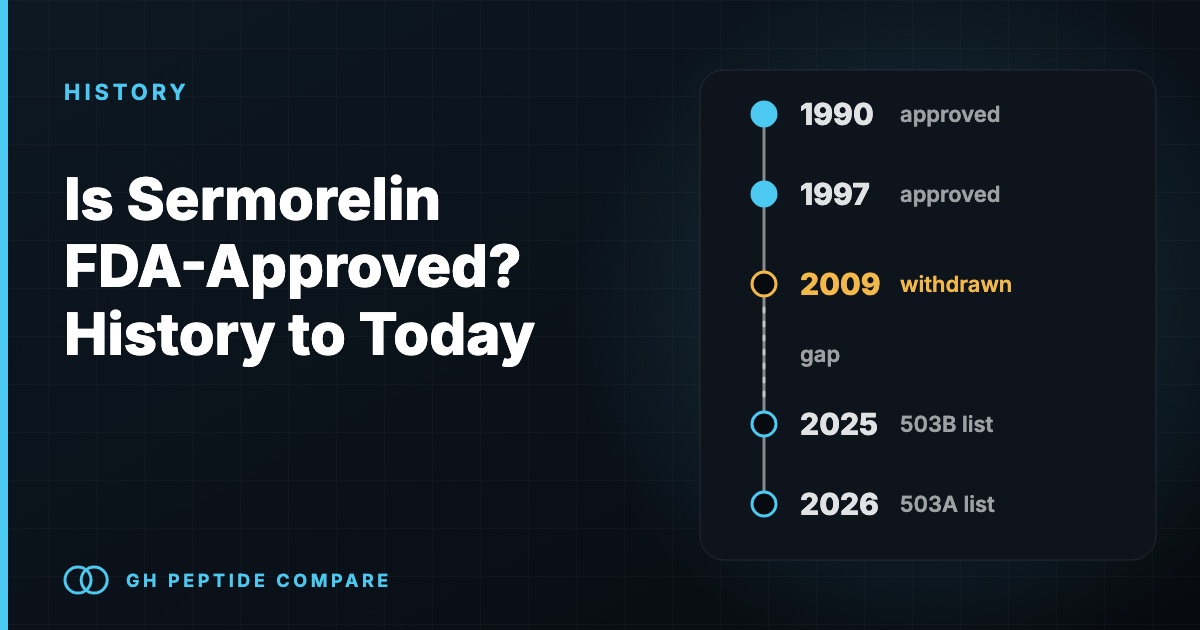
Quick answer: Not today. Sermorelin was FDA-approved under the brand name Geref, first as a diagnostic product in 1990 and then for children with growth failure in 1997. Its maker discontinued it in 2008, and FDA withdrew the approvals effective 2009-06-18. A 2013 FDA notice found that neither approval ended over safety or effectiveness concerns. Compounded sermorelin sold now is not FDA-approved.
"Is sermorelin FDA-approved?" has two honest answers, and the difference between them is where most online confusion starts. Sermorelin was once an approved drug. It is not one now. The compounded product offered by online services today is a different thing from the approved brand, and it is not FDA-approved. This page lays out the dated record, says what each FDA document does and does not mean, and flags where seller pages differ from the primary sources.
Some links on this page are affiliate links to Whoosh Wellness, and we may earn a commission if a reader uses them. The history below comes from FDA documents, not from Whoosh.
A dated timeline
Every date below was read in the cited source on 2026-10-06.
| Date | Event | Source |
|---|---|---|
| 1990-12-28 | FDA initially approves Geref in a single-use ampule form, held by EMD Serono, for evaluating the ability of the pituitary gland to secrete growth hormone | Federal Register notice 2013-03-04; Drugs@FDA application 019863 |
| 1997-09-26 | FDA initially approves Geref in vials for children with idiopathic growth hormone deficiency and growth failure | Federal Register notice 2013-03-04; Drugs@FDA application 020443 |
| 2008-07-11 | By letter, EMD Serono tells FDA the ampule is being discontinued | Federal Register notice 2013-03-04 |
| 2008-12-02 | By letter, EMD Serono tells FDA the vials are being discontinued and asks for withdrawal of that application; on 2008-12-12 it asks for withdrawal of the ampule application | Federal Register notice 2013-03-04 |
| 2009-05-19 | FDA announces in the Federal Register that it is withdrawing approval of both applications | Federal Register notice 2013-03-04, citing 74 FR 23407 |
| 2009-06-18 | The withdrawal of approval takes effect | Federal Register notice 2013-03-04 |
| 2012-10-12 | A citizen petition asks FDA to decide whether the vials were withdrawn for reasons of safety or effectiveness | Federal Register notice 2013-03-04 |
| 2013-03-04 | FDA publishes its determination that both Geref products "were not withdrawn from sale for reasons of safety or effectiveness" | 78 FR 14095, FR Doc 2013-04827 |
| 2024-12-04 | An FDA advisory committee briefing document says that, among growth hormone secretagogues such as CJC-1295, only sermorelin (Geref) was approved for short stature associated with growth hormone deficiency in pediatric patients | FDA briefing document, page 45 |
| 2025-03-21 | FDA's 503B category list, as updated that day, shows sermorelin acetate in Category 1, marked as a component of an FDA-approved drug | FDA 503B bulk drug substances list |
| 2026-05-14 | FDA's 503A category lists, as updated that day, do not include sermorelin | FDA 503A bulk drug substances list |
Two details deserve emphasis. The maker's letters in 2008 were requests to stop selling the products, and FDA's withdrawal of approval followed in 2009. Sources that say "withdrawn in 2008" collapse those steps. And the 2013 notice names no commercial reason for the discontinuation, which matters later in this page.
What the 2013 notice found, and what it did not
The Federal Register notice carries a long title, but its operative finding is a single sentence: FDA determined that the Geref products were not withdrawn for reasons of safety or effectiveness. The notice says its purpose is to allow FDA to approve abbreviated new drug applications, the filings used for generic versions, if all other legal and regulatory requirements are met.
That is a narrow, procedural finding. It answers one question: did the products leave the market because of safety or effectiveness? FDA's answer was no. It does not say FDA considers sermorelin safe or effective for any use today, and it does not endorse any compounded product. The notice states that FDA also evaluated relevant literature and data for possible postmarketing adverse events for both products. This page does not report whether any generic application was filed or approved, because we did not verify that.
The Drugs@FDA entry for the vials carries an annotation about this determination, and lists the product as discontinued, with the label unavailable on that site. That is also why we could not quote the label on the side effects page.
What "compounded" means
Compounding is the preparation of a medication by a pharmacy or facility for an individual patient on a prescriber's order, often by combining or altering ingredients. FDA recognizes two main routes. Pharmacies that compound for individual patients operate under what the law calls section 503A. Outsourcing facilities that prepare drugs in larger quantities operate under section 503B and register with FDA.
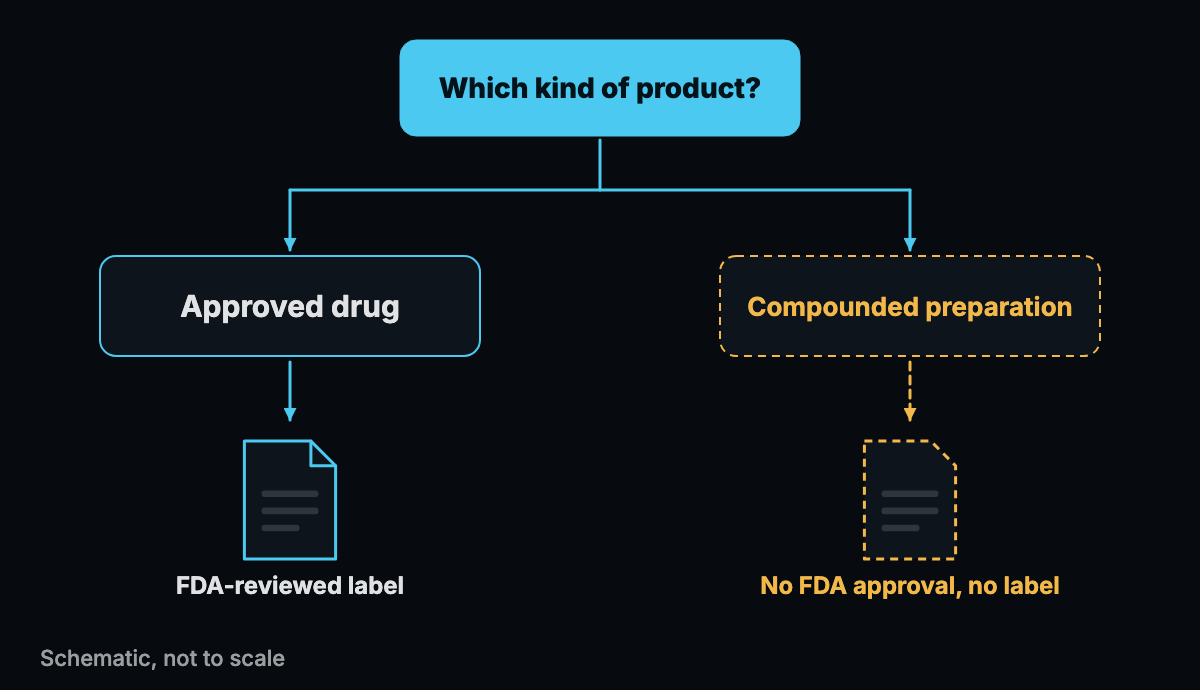
The key point is what compounding is not. A compounded drug is not FDA-approved. FDA has not reviewed that preparation for safety, effectiveness or quality before it is sold, which is why Whoosh's own terms say compounded medications are not reviewed or approved by the FDA for safety or efficacy. The disclaimer on its home page, read 2026-10-06, says its compounded medications are produced in FDA-registered facilities but are not FDA-approved.
So compounded sermorelin is not the old Geref product under another label. It is a different category with a similar active ingredient name and no label of its own.
The two lists, in plain terms
FDA keeps lists of bulk drug substances that compounders have asked to use. Sermorelin appears on one and not on the other, and the difference is easy to misread.
The 503B list (updated 2025-03-21). Sermorelin acetate is in Category 1, which FDA titles "Bulk Drug Substances Under Evaluation." A double-asterisk marks it as a component of an FDA-approved drug. Category 1 is not an approval. It is a holding category while FDA evaluates. A footnote in the same file says FDA does not intend to act against an outsourcing facility for failing to compound according to one provision if it fills orders for a compounded drug that is essentially a copy of an approved drug that has been discontinued and is no longer marketed. We quote that as FDA's enforcement position, not as a finding that such products are appropriate. The same file puts a different peptide, ipamorelin acetate, in Category 2 for significant safety risks. That comparison belongs to our sermorelin vs ipamorelin guide, not here.
The 503A lists (updated 2026-05-14). In the categories we searched, sermorelin does not appear. The document does not state a reason, and we do not offer one.
What follows is limited. A newer version of the 503B file may exist, since the version we reached is the one dated 2025-03-21. And FDA's separate "clinical need" list for 503B substances, last updated in 2023, has no sermorelin entry in either table.
What FDA has and has not said
Pulling the record together, here is what the FDA documents we read establish.
- Geref was approved, for a diagnostic use in 1990 and for pediatric growth failure in 1997.
- The approvals were withdrawn effective 2009-06-18 after the maker discontinued the products.
- FDA determined in 2013 that the withdrawal was not for reasons of safety or effectiveness.
- FDA's December 2024 briefing says sermorelin is the only growth hormone secretagogue among those it discussed to have been approved, for children with a diagnosed deficiency.
- FDA's compounding lists place sermorelin differently on the 503B and 503A sides, as above.
And here is what we did not find. We found no FDA statement approving compounded sermorelin for adults, for wellness or for any other use. We found no FDA safety communication naming sermorelin as its subject, though our search used a limited set of queries and is not proof of absence. Two FDA-hosted recalls from 2019 and 2022 name compounded sermorelin among many products, for sterility assurance and out-of-specification reasons, and both say no adverse events were reported or attributed. Those are about batches, not about the ingredient.
Where seller pages and primary sources differ
Whoosh's blog posts, read 2026-10-06, say that sermorelin was discontinued commercially in 2008 and not withdrawn for safety or efficacy reasons. That matches the 2013 notice. They also give reasons for the discontinuation. One post, dated June 15, 2026, says "manufacturing difficulties," and another, dated June 22, 2026, says the drug was not profitable enough. The FDA notice states neither, and the two posts disagree with each other. We regard the maker's reason as not established.
A Whoosh post also says FDA has not issued safety or efficacy concerns specific to compounded sermorelin produced by licensed, quality-controlled pharmacies. That is Whoosh's statement. The absence of a statement is not an approval, and the same post cannot tell you what FDA would conclude if it reviewed a given compounded product, because FDA does not review them before sale.
Separately, sermorelin appears on the 2026 anti-doping Prohibited List, in the class of growth hormone releasing factors. A Whoosh blog post says compounded sermorelin is not a prohibited substance in a prescription context, and the two statements concern different rules.
What it means for a reader today
The practical reading is short. If someone says sermorelin is FDA-approved, ask which product. The brand was, and is gone. If someone offers a compounded product, it is not FDA-approved, and no regulator has reviewed that preparation before sale. The questions checklist asks which pharmacy prepares a product, whether it is licensed in your state, and what testing exists. For the biology and evidence behind the peptide, the sermorelin profile is the starting point.
Where a prescriber fits
A licensed physician decides whether a prescription is appropriate, and that is true of any compounded or approved medication. Whoosh states that its intake is reviewed individually by a licensed doctor and that completing it does not guarantee a prescription. If you want to see what the service asks, the button below goes to its intake. A licensed physician decides whether a prescription is appropriate, and the compounded products involved are not FDA-approved.
Sources
- Federal Register: Determination That GEREF (Sermorelin Acetate) Injection Was Not Withdrawn From Sale for Reasons of Safety or Effectiveness, 78 FR 14095, 2013-03-04 read 2026-10-06
- Drugs@FDA: Geref application 020443 read 2026-10-06
- Drugs@FDA: Geref application 019863 read 2026-10-06
- FDA Pharmacy Compounding Advisory Committee briefing document, 2024-12-04 read 2026-10-06
- FDA: 503B bulk drug substances categories list, updated 2025-03-21 read 2026-10-06
- FDA: 503A bulk drug substances categories list, updated 2026-05-14 read 2026-10-06
- FDA: 503B bulk drug substances list read 2026-10-06
- FDA: Olympia Pharmacy voluntary recall, 2022-03-10 read 2026-10-06
- FDA: Innoveix Pharmaceuticals voluntary recall, 2019-10-10 read 2026-10-06
- WADA 2026 Prohibited List read 2026-10-06
- Whoosh Wellness: Is sermorelin FDA-approved? (blog, 2026-06-22) read 2026-10-06
- Whoosh Wellness: terms and conditions read 2026-10-06
FAQ
Is sermorelin FDA-approved right now?
No. FDA approved the brand Geref in 1990 and 1997, and withdrew those approvals effective 2009-06-18. Compounded sermorelin is not FDA-approved.
Why was Geref discontinued?
The maker, EMD Serono, notified FDA of the discontinuation in 2008. The 2013 notice rules out safety or effectiveness as the reason and names no commercial reason. Seller blog posts give differing reasons, which we do not regard as established.
Does the 2013 notice mean FDA says sermorelin is safe?
No. It is a narrow finding about why the approved products left the market. It is not an endorsement of sermorelin or of any compounded product.
What does Category 1 on the 503B list mean?
FDA titles Category 1 "Bulk Drug Substances Under Evaluation." Sermorelin acetate is marked as a component of an FDA-approved drug. Category 1 is not an approval.
Is compounded sermorelin legal?
Compounding is a recognized pharmacy practice, but this page does not give legal advice and we did not verify the legal status of any particular product. A compounded preparation is not FDA-approved, and a licensed physician decides whether a prescription is appropriate.
Why is sermorelin not on the 503A lists?
FDA's document does not say, and we do not speculate.
Not medical advice. See the medical disclaimer.