Quick answer: Ipamorelin and tesamorelin trigger growth hormone release through different routes. Tesamorelin imitates the releasing hormone and is an FDA-approved drug with one narrow labelled use. Ipamorelin activates ghrelin receptors and has never been approved; FDA's own briefing says it found no human effectiveness evidence it could use. Studies of one cannot be read across to the other.
Both names appear in peptide blends and on clinic menus, which is why people search for them together. This page uses FDA briefings, the tesamorelin label and published abstracts to show how they differ. It does not choose between them. For the single-peptide pages, see the ipamorelin profile and the tesamorelin profile.
The two side by side
| Question | Ipamorelin | Tesamorelin | Source |
|---|---|---|---|
| Receptor route | Ghrelin receptors, per FDA; a "ghrelin mimetic" | Analog of growth-hormone-releasing factor, per the label | FDA ipamorelin briefing; Egrifta SV label |
| Size | Five amino acids | 44-amino-acid human sequence with an added hexenoyl group | FDA briefing; label |
| FDA status | Never approved; not a component of an approved drug | Approved, initial U.S. approval 2010 | FDA briefing; label |
| Compounding lists | 503B Category 2 (added 2023-09-29); not on any 503A list | Not named in the lists we read | 503B list; safety-risks page |
| Human route studied | Intravenous | Subcutaneous, the labelled route | FDA briefing; label |
| Half-life in humans | About 2 hours after an intravenous infusion in healthy men, as FDA describes the study | 8 minutes in healthy subjects after one subcutaneous injection | FDA briefing; label |
| Whoosh offers this | No | No | Whoosh review |
As of 2026-10-06. The 503B file is dated March 21, 2025; we found no newer version.
How each works
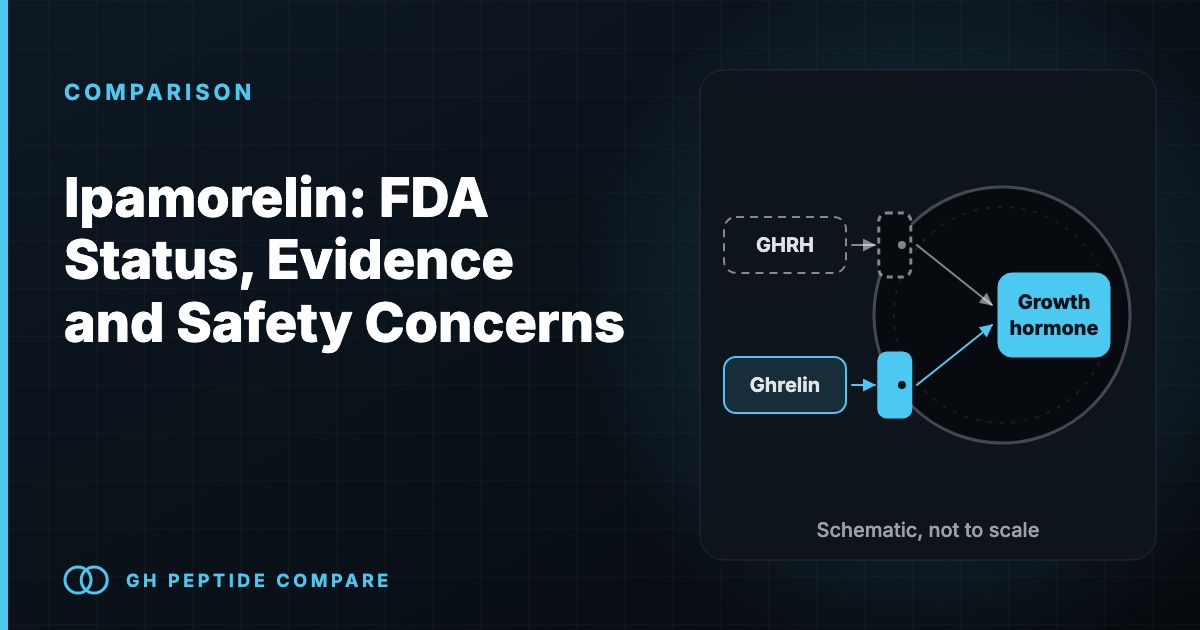
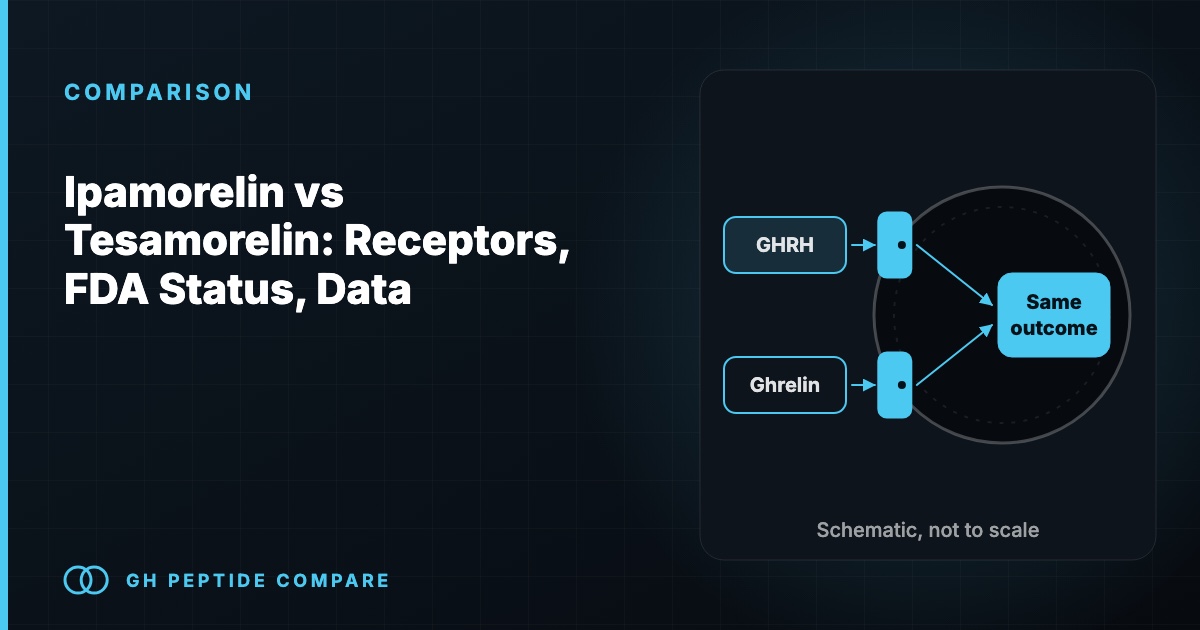
Think of two doors into the same room. Tesamorelin uses the door that the brain's own releasing hormone uses; ipamorelin uses the door that ghrelin, the so-called hunger hormone, uses. FDA's briefing says ipamorelin acts on ghrelin receptors in the hypothalamus and on pituitary cells and, in the briefing's words, does so without major effects on ACTH or cortisol. The discovery paper by Raun and colleagues (1998) reached that last point in swine, at doses far above those needed for growth hormone release, so it is animal evidence.
FDA adds a condition: some residual pituitary growth hormone output has to remain for ipamorelin to raise circulating levels.
FDA status
Ipamorelin. FDA's October 2024 briefing states there is no USP monograph and that neither ipamorelin free base nor its acetate is a component of an approved drug. On the 503B list, ipamorelin acetate is in Category 2, which FDA defines as significant safety risks pending further evaluation. The 503A nomination was withdrawn, and the Pharmacy Compounding Advisory Committee had voted 0 to 12, with one abstention, against putting either form on the 503A list on 2024-10-29. Those votes are advisory. FDA says it would consider action under its general enforcement policies against a facility compounding a Category 2 substance. Any ipamorelin product that is compounded is not FDA-approved.
Tesamorelin. Approved under the brand Egrifta. Its status rests on a manufacturer's label, trial data and postmarketing duties. The label covers one population, and the tesamorelin profile quotes the indication.
One approved, one never approved
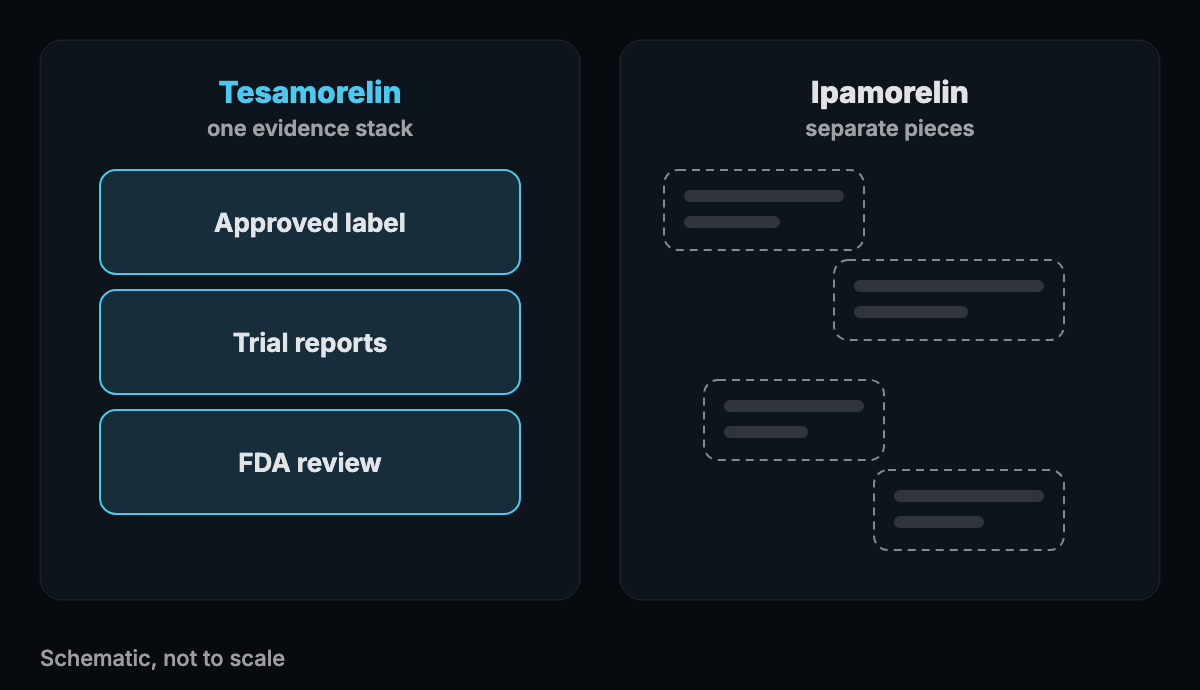
This is the difference that matters most when reading studies, and it changes what each kind of paper can tell you.
An approved drug has a defined evidence trail. For tesamorelin, regulators saw two placebo-controlled trials in adults with HIV lipodystrophy, with the label stating how many people took part and what happened to them. The label's visceral fat results ran from 21 to 31 square centimeters below placebo in the two trials, with intervals that excluded zero. You can look up inclusion rules, adverse events and warnings in one place.
A never-approved substance has scattered evidence. For ipamorelin, FDA identified only a few human studies and said they cannot support the compounding uses nominated. When you meet a claim about ipamorelin, four questions help:
- Which route was used? FDA found no pharmacokinetic or pharmacodynamic information for the subcutaneous route the nominators proposed. The human data were intravenous.
- Who was studied? One study enrolled 48 healthy men; another enrolled hospitalized adults after bowel surgery. Neither is a general adult population.
- What was measured? The pharmacology study, as FDA describes it, reported no effectiveness data on diagnosing or addressing growth hormone deficiency.
- Did the result hold up? The surgical trial's main endpoint, time to first tolerated meal, was 25.3 hours against 32.6 hours, which the trial's abstract gives as not statistically significant (p = 0.15).
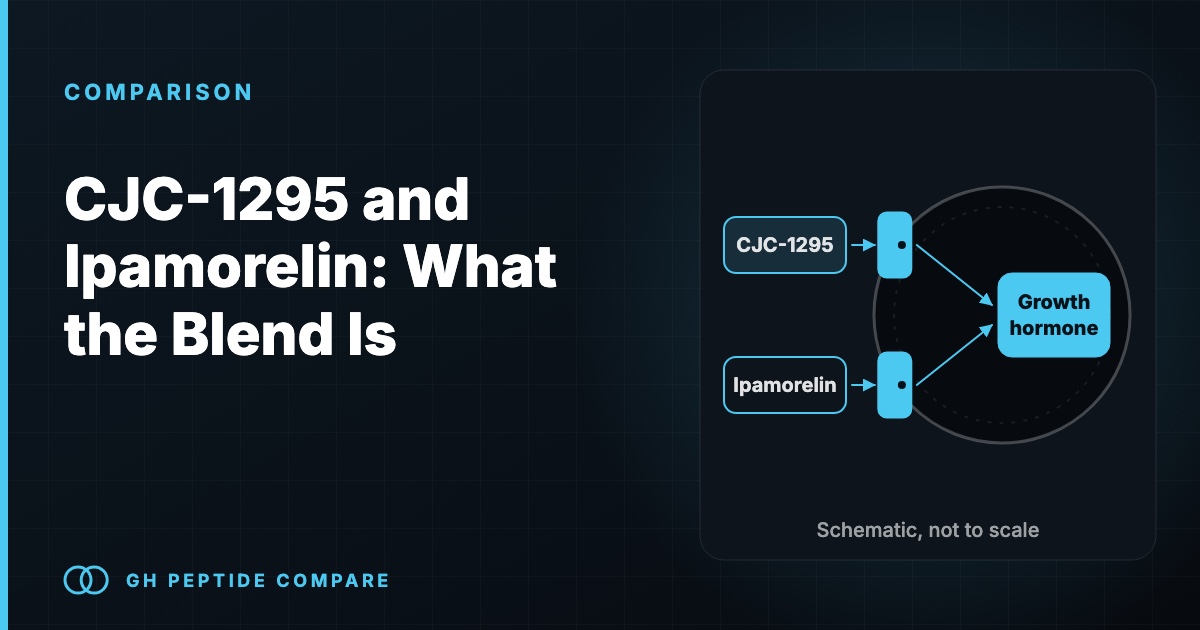
What this means in practice. The practical rule is simple. A tesamorelin result may be quoted for the labelled group and no one else. An ipamorelin result may be quoted for the exact route, group and endpoint studied, and FDA's reading is that these do not establish effectiveness. A combined product, such as the tesamorelin-ipamorelin blend named in an FDA warning letter, has the evidence of neither partner.
Human evidence
Ipamorelin. Per FDA's description, a 1999 dose-escalation study gave intravenous ipamorelin or placebo to 48 healthy men and, as FDA words it, did not state any adverse events and reported no effectiveness data. The 2014 phase 2 ileus trial (Beck and colleagues) enrolled 117 hospitalized adults, analyzed 114, and found no significant difference in the main endpoint. FDA reports that development for that use was then discontinued. FDA found no published human data for the subcutaneous route.
Tesamorelin. The label describes studies of 412 and 404 HIV-infected adults with lipodystrophy and excess abdominal fat, each lasting 26 weeks. Those results are specific to that population.
| Claim as marketed | Who says it | What supports it | Grade |
|---|---|---|---|
| Ipamorelin does not raise cortisol | Peptide marketing sites; FDA repeats it as a description | A 1998 swine study; no human data on the question in FDA's briefing | ANIMAL OR LAB ONLY |
| Ipamorelin supports weight loss, anti-aging or bodybuilding goals | Medical spas and wellness clinics, per FDA | FDA's briefing found no effectiveness data it could use | NO PUBLISHED DATA |
| Ipamorelin speeds recovery after bowel surgery | Not claimed commercially; studied | One phase 2 trial; main endpoint not significant | STUDIED IN HUMANS |
| Tesamorelin reduces abdominal fat | The Egrifta label | Two label trials in HIV-infected adults with lipodystrophy | APPROVED LABEL |
| Tesamorelin is a weight loss peptide | Some online sellers | The label says it is not indicated for weight loss management | CONTRADICTED BY SOURCE |
| "Research" tesamorelin or ipamorelin equals the approved product | Online vendors | FDA's 2026 warning letters classify such products as unapproved new drugs | NO PUBLISHED DATA |
Safety statements as the sources report them
Ipamorelin. FDA's safety page says compounded drugs containing ipamorelin acetate may pose immunogenicity risk for certain routes, notes it contains unnatural amino acids, and says a published study identified serious adverse events including death when ipamorelin was given intravenously for gastric motility. In that trial, per FDA, two participants who received ipamorelin died after bowel resection for colon cancer, and FDA says it is unclear whether the deaths were related to the drug. FDA also reports higher rates in the ipamorelin group of low potassium (12.5% against 3.4%) and high blood sugar at discharge (14.3% against 8.6%). FDA says it is concerned that risks listed on approved growth hormone labels, such as glucose intolerance, fluid retention and neoplasm risk, may apply to secretagogues, and describes this as concern, not a finding.
Tesamorelin. The label lists neoplasm risk, elevated IGF-1 (it reports 47% of patients above two standard deviation scores at 26 weeks), fluid retention, glucose intolerance or diabetes, hypersensitivity in 4% of patients, and injection-site reactions in 25% against 14% on placebo. It also lists increased mortality in acute critical illness, and contraindicates use in pregnancy and in active malignancy.
Why the gap in evidence matters to a reader
Search results often show the two names in one product title, so the labels get blurred. An approved drug's page lists who was studied and what was found, while a never-approved substance has no such page, only fragments. When a clinic describes tesamorelin, ask whether the use named matches the label. When a clinic describes ipamorelin, ask what document the claim comes from, and whether that document concerned the same route, the same people and the same endpoint. FDA's briefing is blunt that the evidence of effectiveness is limited for any route studied.
Marketing and enforcement
On 2026-08-24, FDA's warning letters to NuScience Peptides and Royal Peptides named a "Tesamorelin Ipamorelin Blend" and a similar dual-peptide product as unapproved new drugs. FDA states that labels reading research use only did not change the products' intended use when site tools such as peptide calculators showed human drug use. The letters name ipamorelin only inside those blends.
Who offers what
Whoosh offers neither peptide. As stated by Whoosh, read 2026-10-06, it offers compounded sermorelin, and compounded medications are not FDA-approved. A licensed physician decides whether any prescription is appropriate. See the Whoosh Wellness sermorelin review for the plain list of what it does and does not offer.
Which question are you asking?
| Situation | What the sources say | Page to read |
|---|---|---|
| I need to know which one holds an approval | Tesamorelin has a current label; ipamorelin has never been approved | Tesamorelin profile |
| I saw ipamorelin blended with another peptide | FDA's one statement on a CJC-1295 blend is about a facility that compounded it in 2019 and 2020 | CJC-1295 and ipamorelin |
| I want to know what ipamorelin studies exist | Intravenous studies in healthy men and surgical patients; none by injection under the skin | Ipamorelin profile |
| I want all three growth hormone peptides in one table | A sourced three-way table | Three-way table |
| I want the closest approved comparison to sermorelin | Tesamorelin, with a different label | Sermorelin vs tesamorelin |
FAQ
Is ipamorelin FDA-approved?
No. FDA's briefing states it is not a component of an approved drug, and the advisory committee voted against listing it on the 503A bulks list.
Is tesamorelin approved for weight loss?
No. The label states it is not indicated for weight loss management.
Why compare an approved drug with an unapproved one?
Because they are sold side by side, and the difference in evidence is the useful lesson. A label-backed claim and a claim with no label are different kinds of statement.
Did ipamorelin cause the deaths in that trial?
The sources do not say so. FDA says it is unclear whether the two deaths in the intravenous ileus trial were related to ipamorelin.
Do they share a receptor?
No. FDA describes ipamorelin as acting on ghrelin receptors; the tesamorelin label calls it a growth hormone-releasing factor analog.
Could one study cover both?
The sources we read include no head-to-head study.
Sources
- FDA briefing document, ipamorelin, PCAC October 29, 2024 read 2026-10-06
- FDA final summary minutes, October 29, 2024 read 2026-10-06
- FDA: certain bulk drug substances that may present significant safety risks read 2026-10-06
- FDA 503B category list, March 21, 2025 read 2026-10-06
- EGRIFTA SV label, DailyMed read 2026-10-06
- Beck et al. 2014, PubMed 25331030 read 2026-10-06
- Raun et al. 1998, PubMed 9849822 read 2026-10-06
- FDA warning letter, NuScience Peptides LLC, 2026-08-24 read 2026-10-06
Not medical advice. See the medical disclaimer.