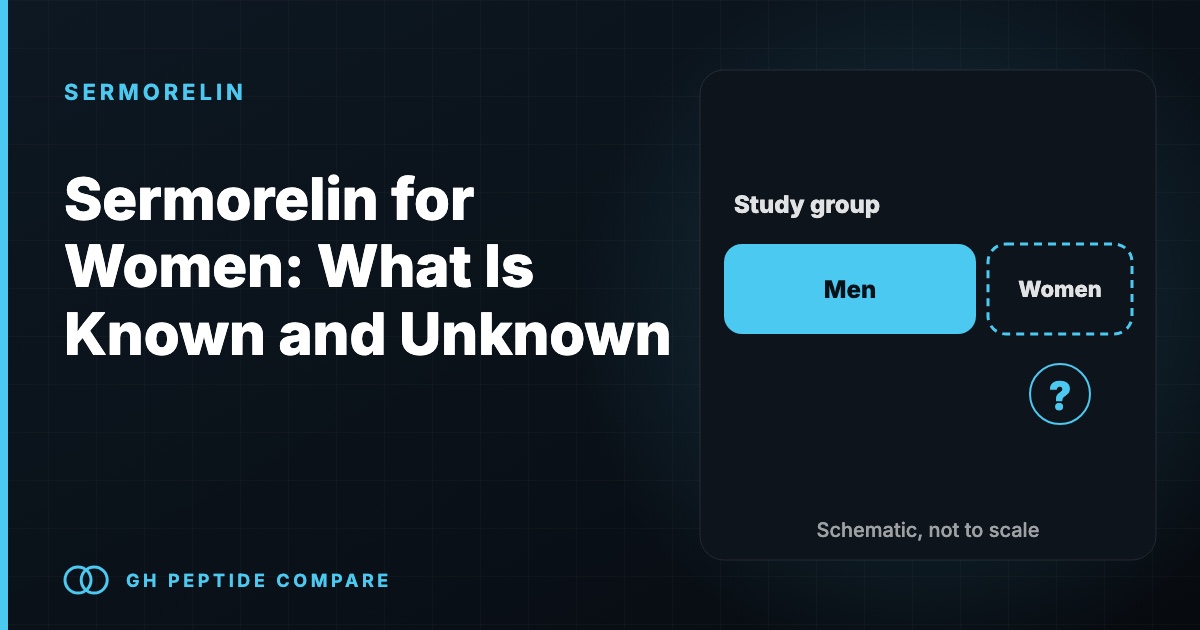
Quick answer: Very little published adult research on sermorelin-type peptides reports results for women. The best-known study, from 1997, enrolled ten women and nine men aged 55 to 71 and tested a GHRH-(1-29) analog. Hormone levels rose in both sexes, but its abstract reports gains in lean mass, insulin sensitivity, well-being and libido in men only. We found no FDA or medical-society statement on these peptides in women. Compounded sermorelin is not FDA-approved.
A search for sermorelin aimed at women turns up pages about menopause, energy and body shape. The studies behind those pages are mostly of men or of mixed small groups. This article reads what was done, who was in it, and where the honest answer is "we do not know." The wider background is on the sermorelin profile, and the question of weight in particular is covered in sermorelin for weight loss.
Some links on this site are affiliate links, which means we may earn a commission. The one that appears near the end of this page is marked before it.

The evidence by study population
| Source | Who was in it | What it reported | Limits |
|---|---|---|---|
| Khorram 1997 (JCEM) | 10 women, 9 men, aged 55-71, five months | Overnight GH and IGF-I rose in both sexes; lean mass, insulin sensitivity, well-being and libido improved in men only | Small; a GHRH-(1-29) analog; healthy older adults |
| Khorram 1997 (immune outcomes) | Same cohort | No sex differences in the immune response; no adverse effects reported in the abstract | Laboratory immune measures, not clinical outcomes |
| Vittone 1997 | 11 men, aged 64-76 | Mixed strength results, no weight or DEXA change | Men only |
| Corpas 1992 | Young and old men | GH and IGF-I changes at higher intake | Men only; 14 days |
| Sigalos 2017 | 14 men from a chart review | IGF-1 rose in a combination product | Men only; a blend; retrospective |
| Orrego 2001 | 8 older women and 9 younger women | Physiology only, no product given | No intervention arm |
As of 2026-10-06. This is our reading of PubMed abstracts, not a systematic review.
Who was in the studies
This is the section that matters most for a woman reading about sermorelin, so it goes slowly.
The one adult study with women and sex-specific results. Khorram and colleagues enrolled ten women and nine men between 55 and 71 years of age in a single-blind, randomized, placebo-controlled study. After four weeks of saline, participants moved to a norleucine-substituted GHRH-(1-29) analog for sixteen weeks. The abstract does not call the study drug sermorelin, so we call it what the abstract calls it: a GHRH analog from the same 29-amino-acid family. Whether it is the same compound as a compounded sermorelin product was not confirmed.
The findings by sex are the reason this study matters:
- Overnight growth hormone rose in women (P<0.01) and in men (P<0.05), and IGF-I and IGFBP-3 rose.
- Skin thickness increased in both sexes.
- Lean body mass increased in men only.
- Insulin sensitivity improved in men only.
- General well-being and libido improved in men but not in women. Sleep quality was unaffected in both.
- The abstract's authors describe "anabolic effects favoring men more than women" and call for further studies to define the gender differences.
That is the whole of the sex-specific adult record we located for these peptides. A group of ten is too small to rule anything in or out for women, and the abstract's own result is that the women did not show the changes the men did.
Every other adult study was of men. Corpas and colleagues in 1992 studied younger and older men. Vittone in 1997 studied eleven older men. Sigalos in 2017 reviewed charts of men on testosterone, using a blend that was not sermorelin alone. None of these says anything about women, and they should not be read as if they did.
What a related FDA document shows about who gets studied. In FDA's December 2024 briefing for its advisory committee on CJC-1295, a related GHRH analog, the agency counted 63 healthy adults exposed to one form, and reported that 55 of them, or 87 percent, were men. That is a different peptide, but it illustrates a pattern: when evidence for this family of products is gathered, men dominate it.
Children are a separate case. The 1996 pediatric study of Geref enrolled 110 children with growth hormone deficiency; the abstract does not give the sex split, and it concerns a different population and use. It is not evidence about adult women.
A physiology paper that included only women. Orrego and colleagues in 2001 compared eight elderly women and nine young women, with no product given. Their abstract concludes that "the female somatopause is not associated with a measurable decrease in hypothalamic GHRH output." Somatopause is the term for the age-related decline in growth hormone secretion. The result is about what the hypothalamus does, not about what a peptide would do, and one small physiology study does not settle how the axis behaves in every woman. We report it because it is the one piece of woman-only data we found that bears on the question, and it does not argue for a deficit that a releasing peptide would fill.
Where the data are thin
Plainly, the thin spots are these:
- Premenopausal and perimenopausal women. We found no primary trial of sermorelin or a GHRH-(1-29) peptide in these groups. That is an absence within the searches we ran, not proof that none exists.
- Menopause-specific outcomes. No study we found tested these peptides on symptoms or outcomes tied to menopause. We use the word only to describe the age range in which some marketing is aimed.
- Duration. The women in the Khorram study took the analog for sixteen weeks. Nothing we read follows women for a year or more.
- Dose-response and routes. Studies used particular regimens, and a clinic's regimen may differ. Whoosh offers tablets as well as injections, and we found no oral sermorelin clinical data.
- Safety in pregnancy and breastfeeding. Whoosh's own blog lists pregnancy or breastfeeding as a contraindication and states: "Safety data in pregnant or breastfeeding women is insufficient." We found no FDA or society statement that goes further.
- Any authoritative statement. We looked for an FDA or medical-society statement specific to growth-hormone-axis peptides in women and found none.
How hormone-axis changes in aging women are discussed
Discussions of sermorelin for women often start from the idea that growth hormone declines with age and that a peptide can offset the decline. The sources let us say some things about that and not others.
What is established. Corpas's 1993 review in Endocrine Reviews says a great deal more research is needed to determine whether normalizing GH and IGF-I levels in healthy older people will lead to improvements in physical and psychological functional capacity and quality of life. That is a statement about the open question, not an answer.
What is studied. The Khorram study measured hormone levels, body measures and questionnaires. Hormone levels rose in the women. Reported benefits were found in the men.
What is only claimed. USADA's sermorelin page lists user-reported energy, sleep and vitality gains, then says clinical evidence for anti-aging effects is lacking. A user report is not a trial.
What FDA has said. FDA has said nothing sex-specific about sermorelin that we could find. What it has said is broader. Geref, approved for children with growth hormone deficiency, was discontinued in 2008 and its approval withdrawn effective 2009-06-18. Compounded sermorelin is not FDA-approved. See the FDA status article.
Claims aimed at women, and what supports them
| Claim as marketed | Who says it | What supports it | Grade |
|---|---|---|---|
| Sermorelin supports fat metabolism in women | A Whoosh blog post, per our 2026-10-06 read | No primary trial in women found in our review | NO PUBLISHED DATA |
| Secretagogues such as sermorelin improve body composition and help with fat loss | The same blog, citing "clinical reviews" | Khorram: lean mass up in men only; Vittone: no body-composition change in men | STUDIED IN HUMANS |
| Sermorelin supports sleep quality | Whoosh product pages | Khorram: sleep quality unaffected in both sexes (questionnaire) | STUDIED IN HUMANS |
| Growth hormone peptides suit older women | Various clinics | One physiology study of older women found no measurable decrease in hypothalamic GHRH output | NO PUBLISHED DATA |
Grades are ours, from the abstracts read. A grade of STUDIED IN HUMANS means a human study measured something related, not that it supported the claim.
What to ask a prescriber
Questions worth bringing, written so that any answer can be checked:
- Which published study supports this product for a woman of my age and health? How many women did it include?
- Is the product I would receive a compounded one, and what is the plain-language FDA status? (Compounded drugs are not FDA-approved.)
- Which pharmacy prepares it, and how is quality tested?
- What will you monitor, how often, and what are the reasons to stop?
- Are there reasons my health history or any plans for pregnancy, or breastfeeding, would change this conversation?
The one-page checklist puts these in printable form. The questions on dosage belong with the prescriber, which is why our dosage article prints no figures.
Where Whoosh Wellness fits
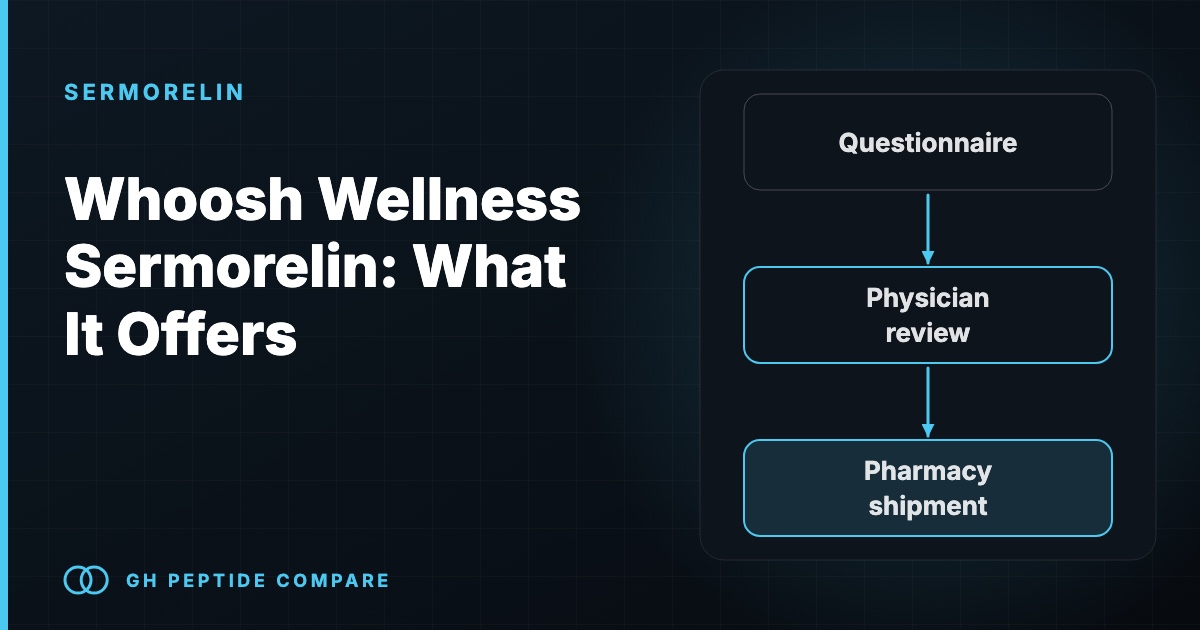
Whoosh Wellness is this site's affiliate partner. As stated by Whoosh, read 2026-10-06, its sermorelin service begins with a questionnaire that a licensed physician reviews, and if a prescription is written, a licensed pharmacy compounds the medication and ships it. Whoosh states that completing an intake does not guarantee a prescription and that its terms describe compounded medications as not reviewed or approved by the FDA. Whoosh offers sermorelin; it does not offer ipamorelin, CJC-1295, tesamorelin or MK-677. Its women's blog makes the fat-metabolism statements shown in the table above, which this page reads as claims, and we found no primary trial in women to support them. The Whoosh review describes the service and where its own pages disagree.
This is an affiliate link, and we may earn a commission if you use it, at no extra cost to you. Using it starts an intake and is not a purchase.
A licensed physician decides whether a prescription is appropriate. Nothing here predicts what sermorelin will do for any woman, and the intake does not promise approval.
Sources
- PubMed: Khorram, Laughlin, Yen, J Clin Endocrinol Metab 1997, GHRH analog in older men and women read 2026-10-06
- PubMed: Khorram et al., 1997, immune outcomes in the same cohort read 2026-10-06
- PubMed: Vittone et al., Metabolism 1997 read 2026-10-06
- PubMed: Corpas et al., J Clin Endocrinol Metab 1992 read 2026-10-06
- PubMed: Corpas, Harman, Blackman, Endocrine Reviews 1993 read 2026-10-06
- PubMed: Sigalos et al., Am J Mens Health 2017 read 2026-10-06
- PubMed: Orrego et al., 2001, somatopause in elderly women read 2026-10-06
- PubMed: Thorner et al., 1996, pediatric Geref study read 2026-10-06
- FDA: advisory committee briefing on CJC-1295, December 4, 2024 read 2026-10-06
- USADA: What should athletes know about sermorelin read 2026-10-06
- Federal Register: Geref determination, 2013-03-04 read 2026-10-06
- Whoosh Wellness: terms and conditions read 2026-10-06
FAQ
Has sermorelin been studied in women?
A little. One 1997 study of a GHRH-(1-29) analog enrolled ten women and nine men aged 55 to 71. Its abstract reports hormone increases in both sexes and body and well-being changes in men only.
Did the women in that study see benefits?
The abstract reports lean mass, insulin sensitivity, well-being and libido improved in men but not in women. Skin thickness increased in both. We do not describe that as a benefit; it is what was measured.
Is sermorelin approved for women?
No. Geref was approved for children with growth hormone deficiency, and FDA withdrew approval effective 2009-06-18. Compounded sermorelin is not FDA-approved.
Is sermorelin considered during pregnancy or breastfeeding?
Whoosh's own blog lists both as contraindications and says safety data are insufficient. We found no authoritative statement beyond that.
Does sermorelin help with menopause symptoms?
We found no trial testing it for that. This site does not make claims about conditions, and no source we read supports one.
What is somatopause?
It is the term for the age-related decline in growth hormone secretion. One small 2001 study of older women found no measurable decrease in hypothalamic GHRH output.
Not medical advice. See the medical disclaimer.