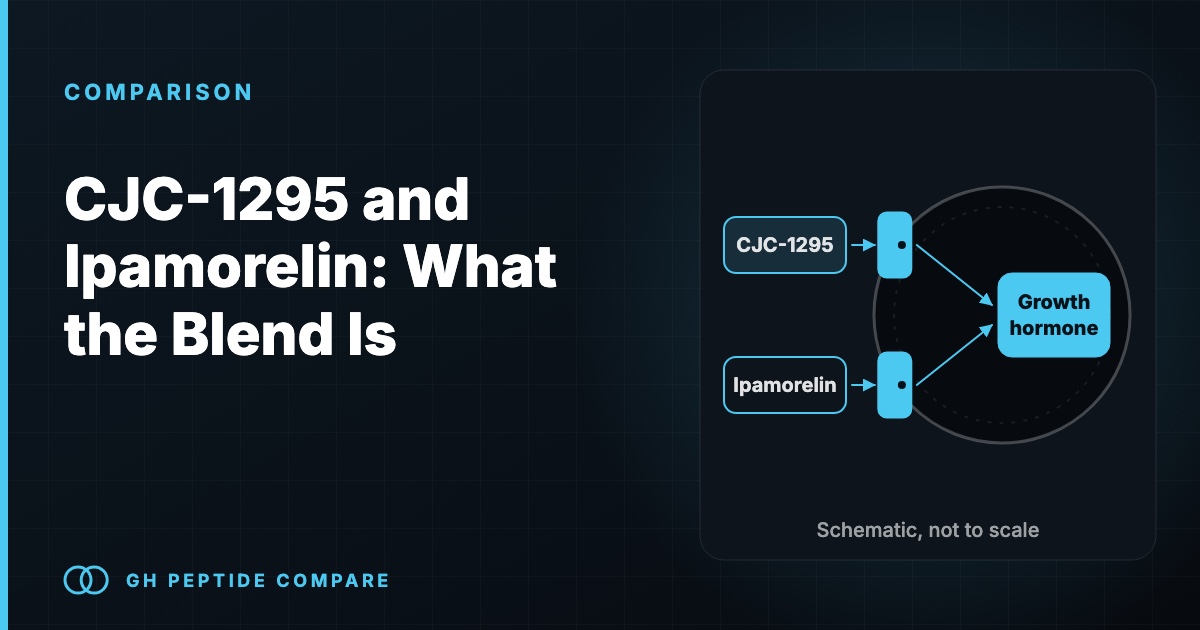
Quick answer: The CJC-1295 and ipamorelin blend pairs a growth-hormone-releasing-hormone (GHRH) analog with a ghrelin-receptor agonist in one product. Sermorelin is a single GHRH analog. FDA says no form of CJC-1295 or ipamorelin is a component of an approved drug, and it made no safety or efficacy finding about the pair. Whoosh offers compounded sermorelin, which is not FDA-approved, and does not offer ipamorelin, CJC-1295 or any blend of them.
If a clinic menu lists "CJC-1295 with ipamorelin" beside sermorelin, the three names can look like variations on one idea. They are not. This page keeps the blend apart from its two parts and from sermorelin, and says what each source covers. For the single-peptide pages, see the ipamorelin profile, the blend profile and the sermorelin profile.
The blend and sermorelin at a glance
| Question | Sermorelin | CJC-1295 with ipamorelin | Source |
|---|---|---|---|
| What is the product? | One peptide, a 29 amino acid GHRH analogue | Two peptides in one vial: a 29 amino acid GHRH analogue plus a pentapeptide that FDA says acts as a ghrelin mimetic | Prakash and Goa; FDA ipamorelin briefing |
| Approved by FDA? | Brand Geref was; approval withdrawn effective 2009-06-18 | No product. Neither ipamorelin nor any CJC-1295 form is a component of an approved drug, per FDA | Federal Register 2013; FDA CJC briefing |
| FDA 503B list (updated 2025-03-21) | Category 1, a component of an approved drug | Ipamorelin acetate in Category 2, added 2023-09-29; CJC-1295 not named | 503B list; FDA safety-risks page |
| FDA 503A list (updated 2026-05-14) | Not on any category | Neither part on any category | 503A list |
| Advisory committee votes | None found in our sources | 2024-10-29 ipamorelin: 0 yes, 12 no. 2024-12-04 CJC-1295: no more than 1 yes in any form | PCAC minutes |
| Human evidence on the pair | Not applicable | None found in the sources we read; each part has separate, limited data | FDA CJC briefing |
| Compounded as a pair | Not applicable | FDA notes one outsourcing facility did it in 2019 and 2020 and none since | FDA CJC briefing |
| Offered by Whoosh? | Yes, compounded, not FDA-approved | No | Whoosh terms |
Table as of 2026-10-06. Each row was read from the cited source on that date.
How each part works
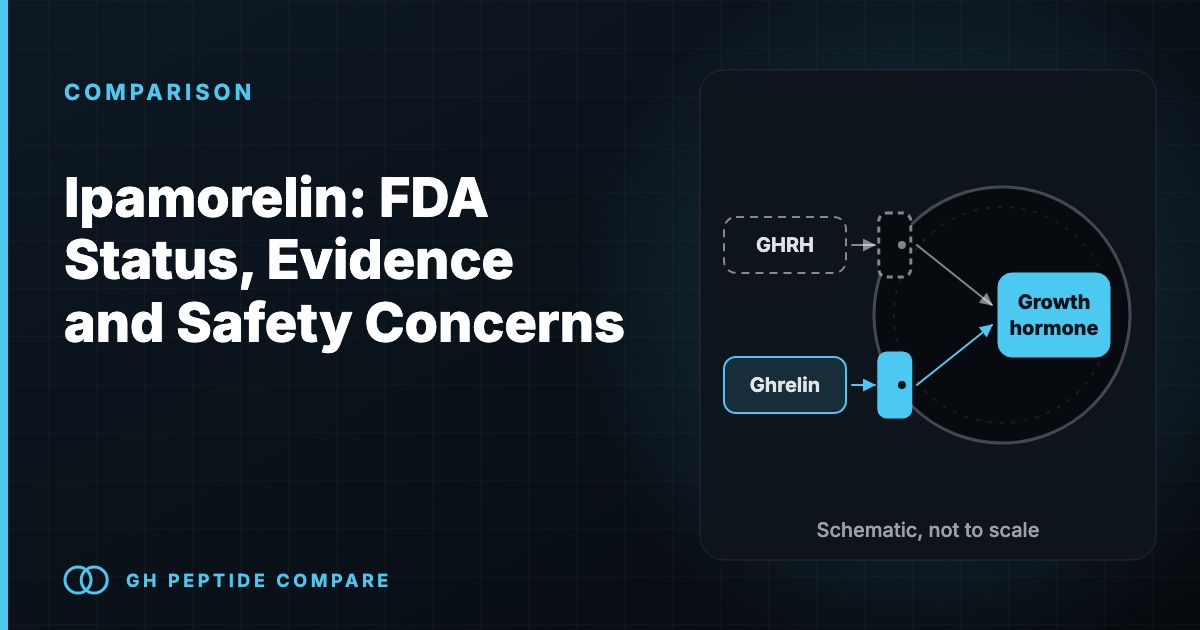
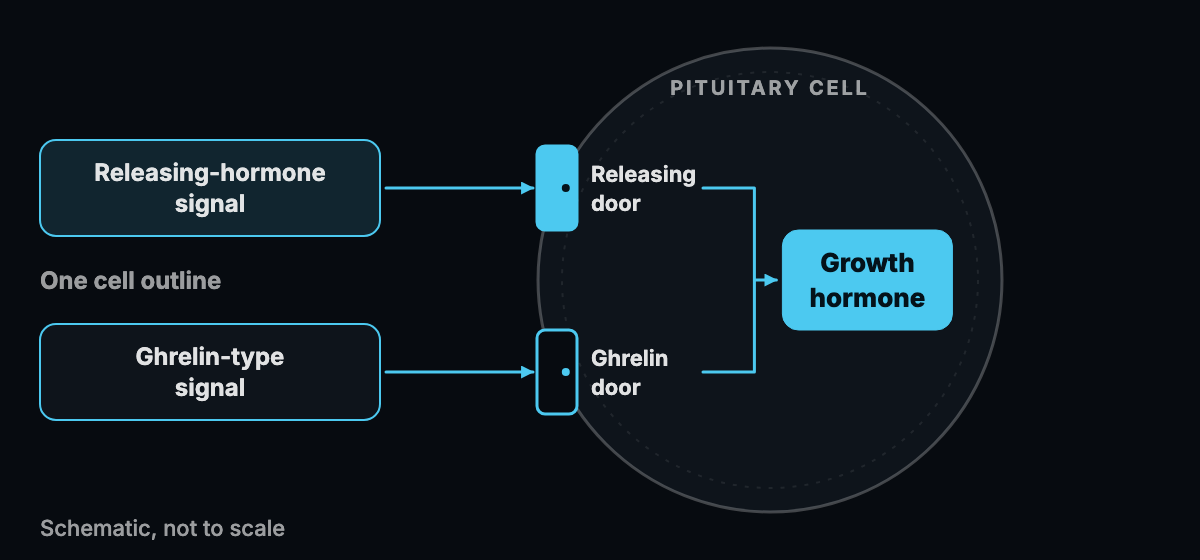
FDA's briefing on ipamorelin calls it a synthetic pentapeptide that "acts as a ghrelin mimetic," and describes its action as stimulating growth hormone release from the anterior pituitary through ghrelin receptors, without major effects on ACTH or cortisol. That is FDA's description of the mechanism; the discovery paper (Raun 1998) tested it in animals and in vitro and found ipamorelin stimulates GH release through a GHRP-like receptor.
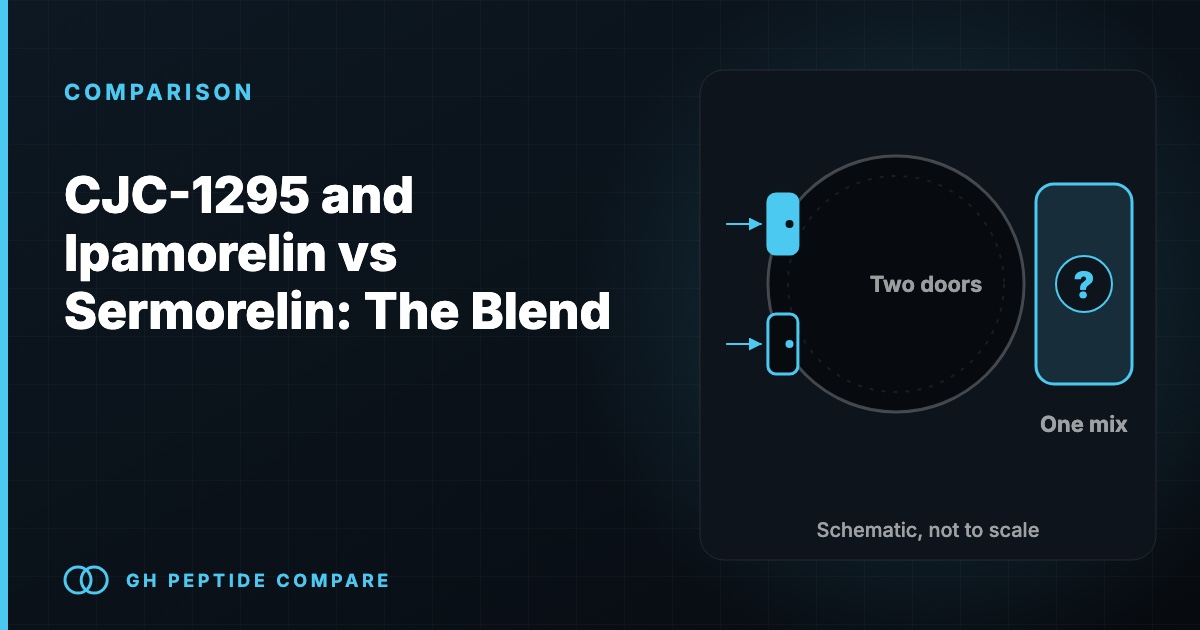
CJC-1295 is a different kind of signal. FDA's briefing describes it as a synthetic analogue of GHRH, the hypothalamic hormone that cues the pituitary. Sermorelin is also a GHRH analogue, per a published review. So the "two doors" idea is straightforward: sermorelin and CJC-1295 use one door, ipamorelin uses another, and the blend uses both. How the two signals behave together in a person is the question the sources do not answer.
What a blend is
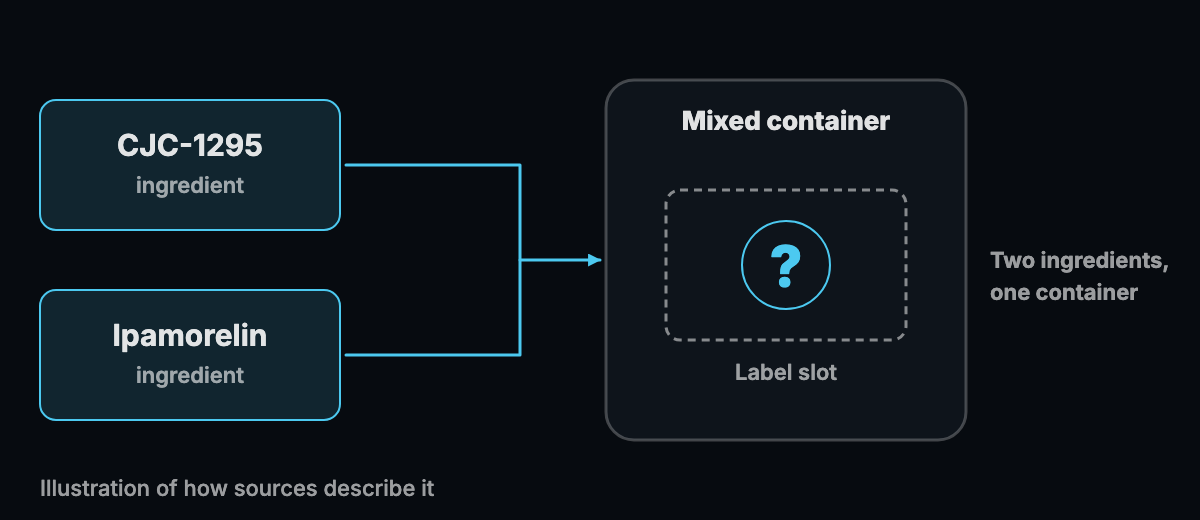
A blend is not a strong version of one peptide. It is a third product that combines a GHRH analog with a ghrelin-receptor agonist, and everything the sources say about each ingredient has to be read as being about that ingredient alone.
Why evidence for one part cannot be carried to the pair. The human data we could verify were collected on single products. For CJC-1295, FDA's briefing found three published studies, all in healthy adults, 63 people in total, and none in anyone with a disease. For ipamorelin, FDA identified one human pharmacology study (Gobburu 1999, per FDA: 48 healthy male subjects given an intravenous infusion, with no effectiveness data) and one phase 2 trial of intravenous ipamorelin after bowel surgery. FDA says it found no pharmacokinetic or pharmacodynamic information for the subcutaneous route that compounders proposed. Neither part has data on what happens when the two are given together, and the sources we read contain no controlled study of the pair.
What FDA says about the blend. In its 2024 briefing on CJC-1295, FDA reports: "Several websites recommend use of CJC-1295 with ipamorelin, stating that the two work synergistically to maximize the amount of GH released." It also relays that an outside expert described a "trending" synergistic combination, and notes the expert did not say which form of CJC-1295 was meant. This is relayed marketing. FDA made no finding that the combination is synergistic, safe or effective. A footnote in the same briefing records that one outsourcing facility compounded a multiple-ingredient injection powder containing both peptides in 2019 and 2020, and that no outsourcing facility has reported compounding CJC-1295 products since 2020.
A mixed vial has no label. FDA's briefing states that compounded drugs "do not include labeling that would adequately warn physicians and patients" of the risks it lists for CJC-1295. That holds for a vial with two ingredients as well. FDA raises separate characterization concerns about each part: for CJC-1295, immunogenicity and peptide-related impurities; for ipamorelin, immunogenicity from aggregation or impurities and the complexity of its unnatural amino acids. A vial with both carries both sets of concerns, and no document describes what a combined product contains or how it behaved in a trial.
Blends in other FDA documents. In August 2026 FDA sent warning letters to two online sellers, NuScience Peptides and Royal Peptides, naming products that mix tesamorelin with ipamorelin as unapproved new drugs. Both products were labeled for laboratory or research use only, and FDA states in the letters that such labeling does not change a product's intended use when a website's claims and tools show human drug use. The letters name ipamorelin only inside those tesamorelin blends. They say nothing about CJC-1295 with ipamorelin.
One more mixture on record. A 2017 chart review by Sigalos and colleagues looked at 105 men on testosterone who had been prescribed a combination of two ghrelin-type peptides and sermorelin; 14 met the inclusion criteria, and IGF-1 rose. That is a different combination, in men only, measured by a surrogate marker, and it should not be read as evidence about CJC-1295 with ipamorelin.
What FDA has said about each
Sermorelin. Geref was approved in 1990 (ampule, for evaluating pituitary GH secretion) and 1997 (vials, for children with idiopathic GH deficiency). EMD Serono notified FDA of discontinuation in 2008 and FDA withdrew approval effective 2009-06-18. A 2013 notice says the products were not withdrawn from sale for reasons of safety or effectiveness. See is sermorelin FDA-approved for the timeline.
Ipamorelin. FDA's briefing says neither the free base nor the acetate is a component of an approved drug and that no USP or NF monograph exists. At the 2024-10-29 PCAC meeting the committee voted 0 yes and 12 no, with one abstention, on placing ipamorelin free base on the 503A bulks list, and the same on ipamorelin acetate. The committee's reason was a lack of information supporting safety and efficacy for the uses FDA evaluated. These votes are advisory. Separately, FDA's 503B list puts ipamorelin acetate in Category 2 (significant safety risks identified, pending further evaluation).
CJC-1295. FDA's briefing says there are "no data on effectiveness" for any of the five CJC-1295 forms it evaluated, and its safety-risks page cites serious adverse events, including increased heart rate and systemic vasodilatory reaction, with limited clinical data. For vote counts and the 2006 trial death, see sermorelin vs CJC-1295.
What the human evidence is
| Claim as marketed | Who says it | What supports it | Grade |
|---|---|---|---|
| The two work synergistically | Websites, as FDA relays | FDA reports the claim and makes no finding; no study of the pair in our sources | NO PUBLISHED DATA |
| Ipamorelin acts on GH without raising cortisol | Marketing and FDA's description of the mechanism | Raun 1998 in swine and in vitro; FDA repeats the mechanism | ANIMAL OR LAB ONLY |
| Ipamorelin supports weight loss, anti-aging or bodybuilding | Medical spa and clinic pages, per FDA | FDA says effectiveness evidence is limited for any route; no data on these goals | NO PUBLISHED DATA |
| Ipamorelin has human trials behind it | Clinic pages | An intravenous trial in 117 surgical patients; the difference in time to first meal was not statistically significant | STUDIED IN HUMANS |
| Sermorelin raises growth hormone in adults | Clinic pages | Small studies of GHRH 1-29 analogs in older adults | STUDIED IN HUMANS |
The ipamorelin ileus trial (Beck 2014) enrolled 117 hospitalized adults and analyzed 114. The ipamorelin group reached a first tolerated meal at a median of 25.3 hours, the placebo group at 32.6 hours, with p = 0.15. FDA records that development for that use was discontinued. The adult sermorelin-type studies used GHRH 1-29 analogs: in 19 adults aged 55 to 71 nocturnal GH rose and body weight was unaffected (Khorram 1997), and in 11 men aged 64 to 76 IGF-I did not change (Vittone 1997).
Safety statements as reported
FDA's safety-risks page raises an immunogenicity concern about ipamorelin acetate for certain routes, tied to aggregation or impurities, and adds that "a study published in literature identified serious adverse events including death when ipamorelin was administered intravenously for improving gastric motility." FDA's briefing gives the detail: two subjects who received ipamorelin died after bowel resection for colon cancer with postoperative complications. FDA writes that it is "unclear whether the deaths reported in the above study were related to ipamorelin," while citing their occurrence, with higher rates of low potassium and high blood glucose among those given ipamorelin, as raising safety concerns. Reported rates were 12.5 percent against 3.4 percent for hypokalemia and 14.3 percent against 8.6 percent for hyperglycemia at discharge.
The briefing adds that all approved recombinant human growth hormone labels carry warnings about neoplasms, glucose intolerance, fluid retention and other effects of elevated GH and IGF-1, and that FDA is concerned similar risks will apply to ipamorelin. Its only report in the adverse event database that involved ipamorelin with sermorelin was a non-serious joint pain case in a 46-year-old man, and FDA says it cannot assess a link. See sermorelin side effects for the sermorelin sources.
Who offers what
Whoosh offers compounded sermorelin, which is not FDA-approved; see the Whoosh Wellness sermorelin review. Whoosh does not offer ipamorelin, CJC-1295 or a blend of them. As stated by Whoosh, read 2026-10-06, a licensed physician decides whether a prescription is appropriate. We print no price, because Whoosh's own pages disagree.
Which question are you asking?
| Situation | What the sources say | Page to read |
|---|---|---|
| A clinic offered one vial with both peptides | FDA made no finding about the pair; there is no label | This page |
| I read the word "synergistic" | FDA relays it as a website claim | This page |
| I want sermorelin against CJC-1295 alone | Compare construction, history and FDA statements | Sermorelin vs CJC-1295 |
| I want the headline comparison | Receptors, approval history and evidence | Sermorelin vs ipamorelin |
| I want questions to bring to a prescriber | A one-page list | Checklist |
FAQ
What is the CJC-1295 and ipamorelin blend?
It is a compounded product that combines CJC-1295, a GHRH analogue, with ipamorelin, which FDA says acts as a ghrelin mimetic. FDA's briefing notes one outsourcing facility made such a product in 2019 and 2020.
Is the blend synergistic?
Websites say so, and FDA reports that claim in its briefing. FDA made no finding either way, and we found no study of the pair.
Is the blend FDA-approved?
No. FDA says neither ipamorelin nor any CJC-1295 form is a component of an approved drug.
Does sermorelin have the same evidence as the blend?
No. Sermorelin's evidence comes from GHRH 1-29 studies and a pediatric approval history. None of it concerns a mixture with ipamorelin.
Why does FDA mention a lack of labeling?
Compounded drugs do not come with the approved-drug label that lists warnings. FDA says that leaves physicians and patients without an adequate warning of the risks it identified.
Can I get the blend through Whoosh?
No. Whoosh does not offer ipamorelin, CJC-1295 or a blend.
Sources
- FDA PCAC briefing on ipamorelin, 2024-10-29 read 2026-10-06
- FDA PCAC final summary minutes, 2024-10-29 read 2026-10-06
- FDA PCAC briefing on CJC-1295, 2024-12-04 read 2026-10-06
- FDA: bulk substances that may present significant safety risks read 2026-10-06
- FDA 503A category list, updated 2026-05-14 read 2026-10-06
- FDA 503B category list, updated 2025-03-21 read 2026-10-06
- FDA warning letter to NuScience Peptides, 2026-08-24 read 2026-10-06
- FDA warning letter to Royal Peptides, 2026-08-24 read 2026-10-06
- Raun et al. 1998 (PubMed 9849822) read 2026-10-06
- Beck et al. 2014 (PubMed 25331030) read 2026-10-06
- Sigalos et al. 2017 (PubMed 28830317) read 2026-10-06
- Khorram et al. 1997 (PubMed 9141536) read 2026-10-06
- Vittone et al. 1997 (PubMed 9005976) read 2026-10-06
- Federal Register 78 FR 14095, 2013-03-04 read 2026-10-06
- Whoosh Wellness terms read 2026-10-06
Not medical advice. See the medical disclaimer.