Quick answer: Sermorelin and ipamorelin both prompt the pituitary gland to release growth hormone, but they use different routes. Sermorelin is an analogue of growth-hormone-releasing hormone (GHRH) whose brand-name drug, Geref, was FDA-approved and later withdrawn. Ipamorelin is a ghrelin mimetic that has never been an FDA-approved drug. Compounded versions of either are not FDA-approved, and neither has FDA-cited evidence of muscle gain or weight loss in healthy adults.
Three takeaways:
- Different receptors. According to FDA's October 2024 briefing, ipamorelin acts as a ghrelin mimetic. Sermorelin is described in the literature as a 29-amino-acid GHRH analogue.
- Different regulatory histories. Sermorelin once had an FDA-approved brand; ipamorelin never has. On FDA's 503B compounding list, sermorelin acetate sits in Category 1 and ipamorelin acetate in Category 2.
- Thin human evidence for both. The adult studies are small, short and mostly in men; the only human ipamorelin data FDA cites used an intravenous route, not the injection clinics describe.
Some links on this page are affiliate links: if you use them we may earn a commission, at no extra cost to you. Read the affiliate disclosure for how that shapes, and does not shape, our writing.
Sermorelin vs ipamorelin at a glance
Every cell below comes from a primary source we read on 2026-10-06. Where two sources use different words, we use the source's own.
| Question | Sermorelin | Ipamorelin | Source |
|---|---|---|---|
| Class | Analogue of growth-hormone-releasing hormone (GHRH), 29 amino acids | Synthetic pentapeptide (5 amino acids), described by FDA as a ghrelin mimetic | Prakash and Goa, BioDrugs 1999; FDA ipamorelin briefing, 2024-10-29 |
| Route to growth hormone | Stimulates GH release from the anterior pituitary | Activates ghrelin receptors in the hypothalamus and on pituitary cells, per FDA | Prakash and Goa; FDA briefing |
| FDA-approved drug? | Geref was approved in 1990 (diagnostic ampule) and 1997 (children's vials); approval withdrawn effective 2009-06-18 | Never an FDA-approved drug; not a component of one | Federal Register notice 2013-03-04; FDA briefing |
| Why Geref ended | Maker EMD Serono notified FDA of discontinuation in 2008; FDA's 2013 notice says not withdrawn for reasons of safety or effectiveness | Not applicable | Federal Register 78 FR 14095 |
| FDA 503B list (outsourcing facilities) | Sermorelin acetate: Category 1, marked as a component of an FDA-approved drug | Ipamorelin acetate: Category 2, significant safety risks identified, pending evaluation | FDA 503B category list, updated 2025-03-21 |
| FDA 503A list (pharmacies) | Not listed | Not listed | FDA 503A category list, updated 2026-05-14 |
| Human evidence | Small adult studies of GHRH-(1-29) peptides; children's studies of Geref | One intravenous study in 48 healthy men; one intravenous ileus trial in 117 patients | PubMed abstracts; FDA briefing |
| On the WADA prohibited list | Yes, section S2 | Yes, section S2 | WADA 2026 Prohibited List |
| Offered by Whoosh Wellness | Yes, compounded (not FDA-approved), as stated by Whoosh | No | Whoosh pages, read 2026-10-06 |
Table current as of 2026-10-06. FDA's 503B file we could reach is dated 2025-03-21; a newer one may exist.
Two doors into the same room
Think of the pituitary cell as a room with growth hormone stored inside. Two different signals can open it. One arrives through the GHRH route, the signal that sermorelin imitates. The other arrives through ghrelin receptors, the route FDA describes for ipamorelin.
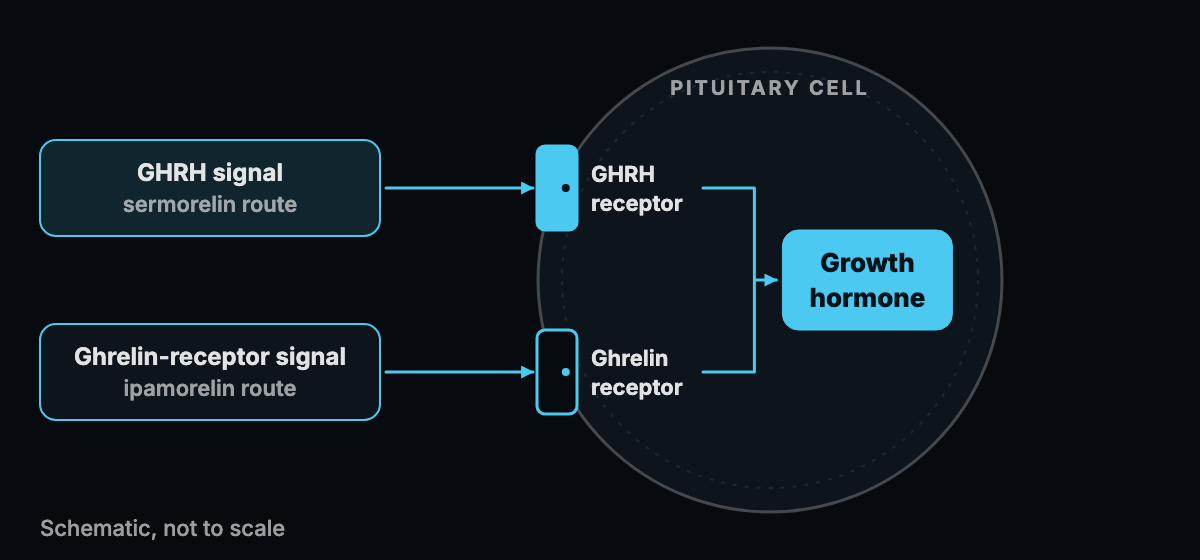
The diagram is schematic, not anatomical. What matters is that the doors are separate. FDA's briefing says ipamorelin works mainly through ghrelin receptors on neurons that carry GHRH, and that some of the person's own pituitary growth hormone secretion must remain for it to raise levels. A GHRH analogue such as sermorelin starts from the other side. Because the routes differ, a result seen with one cannot be assumed for the other, and we compare them in more depth on the three-way table.
Which question are you asking?
| If you are asking | What the sources say | Page to read |
|---|---|---|
| Which one did the FDA ever approve? | Sermorelin as Geref, for children and as a diagnostic ampule; ipamorelin never | Is sermorelin FDA-approved? |
| Which one has human studies? | Both have some, small and narrow; neither has FDA-cited evidence for muscle gain | Ipamorelin profile |
| What is the difference between a releaser and growth hormone itself? | Approved somatropin products are growth hormone; sermorelin prompts its release | Sermorelin vs HGH |
| I saw both offered together at a clinic | A popular blend pairs a GHRH analogue with ipamorelin; FDA made no finding on the pair | CJC-1295 and ipamorelin vs sermorelin |
| What does a physician-supervised service actually offer? | Whoosh offers compounded sermorelin and not ipamorelin | Whoosh review |
| What should I ask before any of these? | Source, status, testing and monitoring | Questions checklist |
What the FDA has said about each
Sermorelin. The FDA approved Geref in 1990 as a diagnostic ampule and in 1997 for children with growth failure from growth hormone deficiency. According to the Federal Register notice of 2013-03-04, the maker, EMD Serono, told FDA in 2008 it was discontinuing both products, and FDA announced it was withdrawing approval effective 2009-06-18. The notice also concluded that safety or effectiveness problems were not why the products left the market. That determination concerns FDA's generic-drug rules; it is not an endorsement of sermorelin sold today. The full dated timeline is on the FDA status page.
Compounded sermorelin is not FDA-approved. FDA's 503B list, updated 2025-03-21, places sermorelin acetate in Category 1, marked as a component of an approved drug. Category 1 is a list status, not an approval. Sermorelin does not appear on the 503A lists updated 2026-05-14.
Ipamorelin. FDA's October 2024 briefing for its compounding advisory committee says neither ipamorelin nor its acetate form is a component of an FDA-approved drug. The committee voted 0 in favor and 12 against placing either form on the 503A list, and the briefing cites a lack of information supporting safety and efficacy. These votes are advisory. On the 503B side, ipamorelin acetate is in Category 2, and FDA's safety-risks page, current as of 2026-04-22, says compounded drugs containing it may pose risk for immunogenicity for certain routes and that a published study found serious adverse events including death with intravenous use for gastric motility. Details are on the ipamorelin profile.
What the human evidence is, and is not
Sermorelin and GHRH peptides. The adult studies used GHRH-(1-29) peptides, as their abstracts describe them, rather than a product named sermorelin in every case. A 1997 trial led by Khorram gave a GHRH-(1-29) analogue for 16 weeks to 19 adults in their mid-50s to early 70s, after a 4-week placebo run-in; nocturnal growth hormone rose, body weight was unaffected, and lean body mass rose in men only. Vittone's 1997 study of 11 men used GHRH-(1-29) nightly for 6 weeks and reported no change in weight or in DEXA measures of muscle and fat. A review by Prakash and Goa says Geref's effects in children had not been directly compared with somatropin.
Ipamorelin. FDA says the only human data it found for growth hormone deficiency came from an intravenous dose-escalation study in 48 healthy men that reported no effectiveness data. In the intravenous ileus trial (Beck 2014; 117 enrolled), time to first tolerated meal was 25.3 hours versus 32.6 hours on placebo, a difference reported as not statistically significant. Two patients who had been given ipamorelin died; FDA says it is unclear whether the deaths were related to ipamorelin.
| Claim as marketed | Who says it | What supports it | Grade |
|---|---|---|---|
| Sermorelin supports the body's own growth hormone release | Whoosh product page, as stated by Whoosh | Studies of GHRH-(1-29) peptides measured higher nocturnal growth hormone in older adults | STUDIED IN HUMANS |
| Sermorelin supports lean body composition | Whoosh product page, as stated by Whoosh | Khorram: lean mass rose in men only; Vittone: no DEXA change | STUDIED IN HUMANS |
| Sermorelin is safer than direct HGH injections | Whoosh blog states this; USADA's page uses similar wording | Prakash and Goa say direct comparison with somatropin is missing in children; no adult comparison found | NO PUBLISHED DATA |
| Ipamorelin is marketed as more selective for growth hormone | Clinic and vendor marketing | Swine study (Raun 1998): no ACTH or cortisol release at high doses | ANIMAL OR LAB ONLY |
| Ipamorelin by subcutaneous injection works as clinics describe | Clinics and medical spas, per FDA's briefing | FDA says no effectiveness or safety data for that route | NO PUBLISHED DATA |
| CJC-1295 with ipamorelin work synergistically | Websites, per FDA's December 2024 briefing | FDA reports the claim and made no finding | NO PUBLISHED DATA |
Who offers which
Whoosh Wellness offers compounded sermorelin, in injection and tablet form, after an online questionnaire that a physician then reads. That is as stated by Whoosh, read 2026-10-06. Whoosh does not offer ipamorelin, CJC-1295, tesamorelin or MK-677, and its own pages disagree with each other on prices, so we print none. Compounded sermorelin is not FDA-approved, and Whoosh's own terms say the same of compounded medications.
Honest fit. If you are specifically weighing sermorelin and want a physician-supervised online route, Whoosh is the one partner we describe. If you came for ipamorelin, this site gives you what FDA says about it, but no seller, because the partner does not offer it. Our Whoosh review lists what its pages say and where they conflict.
This button is an affiliate link, and we may earn a commission if you use it. A licensed physician decides whether a prescription is appropriate, and there is no promise of approval.
Keep reading
Comparisons:
- Sermorelin vs tesamorelin
- Ipamorelin vs tesamorelin
- Sermorelin vs CJC-1295
- CJC-1295 and ipamorelin vs sermorelin
- Sermorelin vs tesamorelin vs ipamorelin
- Sermorelin vs HGH
Profiles: sermorelin, ipamorelin, CJC-1295 and ipamorelin, tesamorelin, and the hub.
Update history
- 2026-10-06: first publication. All sources re-read on this date.
FAQ
Is sermorelin the same as ipamorelin?
No. Sermorelin is a GHRH analogue; FDA describes ipamorelin as a ghrelin mimetic. They have different structures, receptors, regulatory histories and human data.
Is ipamorelin FDA-approved?
No. FDA's 2024 briefing says it is not a component of any FDA-approved drug, and FDA has never approved it.
Is sermorelin FDA-approved?
Not today. Geref's approvals were withdrawn effective 2009-06-18, and compounded sermorelin is not FDA-approved.
Can sermorelin and ipamorelin be used together?
Some websites describe combining a GHRH analogue with ipamorelin. FDA's briefing reports that claim without any finding. See the blend profile.
Does either one build muscle or cause weight loss?
Neither has FDA-cited evidence of that in healthy adults. Khorram and Vittone reported unchanged body weight with a GHRH-(1-29) peptide.
Why does Whoosh offer sermorelin and not ipamorelin?
Whoosh does not say. Its pages list sermorelin among its products and never mention ipamorelin.
Are they allowed in sport?
WADA's 2026 Prohibited List names both in section S2. USADA says a therapeutic use exemption for sermorelin is highly unlikely.
Sources
- FDA: Pharmacy Compounding Advisory Committee briefing on ipamorelin, 2024-10-29 read 2026-10-06
- FDA: PCAC final summary minutes, 2024-10-29 read 2026-10-06
- FDA: 503B bulk drug substances category list, updated 2025-03-21 read 2026-10-06
- FDA: 503A bulk drug substances category list, updated 2026-05-14 read 2026-10-06
- FDA: bulk drug substances that may present significant safety risks read 2026-10-06
- Federal Register: Determination that Geref was not withdrawn for safety or effectiveness, 2013-03-04 read 2026-10-06
- Khorram et al., J Clin Endocrinol Metab 1997 (PubMed 9141536) read 2026-10-06
- Vittone et al., Metabolism 1997 (PubMed 9005976) read 2026-10-06
- Prakash and Goa, BioDrugs 1999 (PubMed 18031173) read 2026-10-06
- Beck et al. 2014, ipamorelin ileus trial (PubMed 25331030) read 2026-10-06
- Raun et al. 1998, ipamorelin discovery paper (PubMed 9849822) read 2026-10-06
- WADA 2026 Prohibited List read 2026-10-06
- USADA: What should athletes know about sermorelin? read 2026-10-06
- Whoosh Wellness: sermorelin product page read 2026-10-06
- Whoosh Wellness: terms and conditions read 2026-10-06
Not medical advice. See the medical disclaimer.