Quick answer: Ipamorelin is a synthetic five-amino-acid peptide that FDA describes as a ghrelin mimetic. It has never been an FDA-approved drug. FDA's own briefing says the human data it found came from intravenous use, reported no effectiveness data for growth hormone deficiency, and included two deaths in an ileus trial whose relation to ipamorelin FDA calls unclear. On FDA's 503B list it is in Category 2. Whoosh does not offer ipamorelin.
- Class and receptor
Synthetic pentapeptide, a ghrelin mimetic acting on ghrelin receptors, per FDA's 2024 briefing
- FDA status
Never an approved drug; 503B Category 2 (significant safety risks, pending evaluation); not on the 503A lists
- Route as described in sources
Intravenous in the human studies FDA cites; no human data for subcutaneous injection
- Whoosh offers this
No
What ipamorelin is and how it works
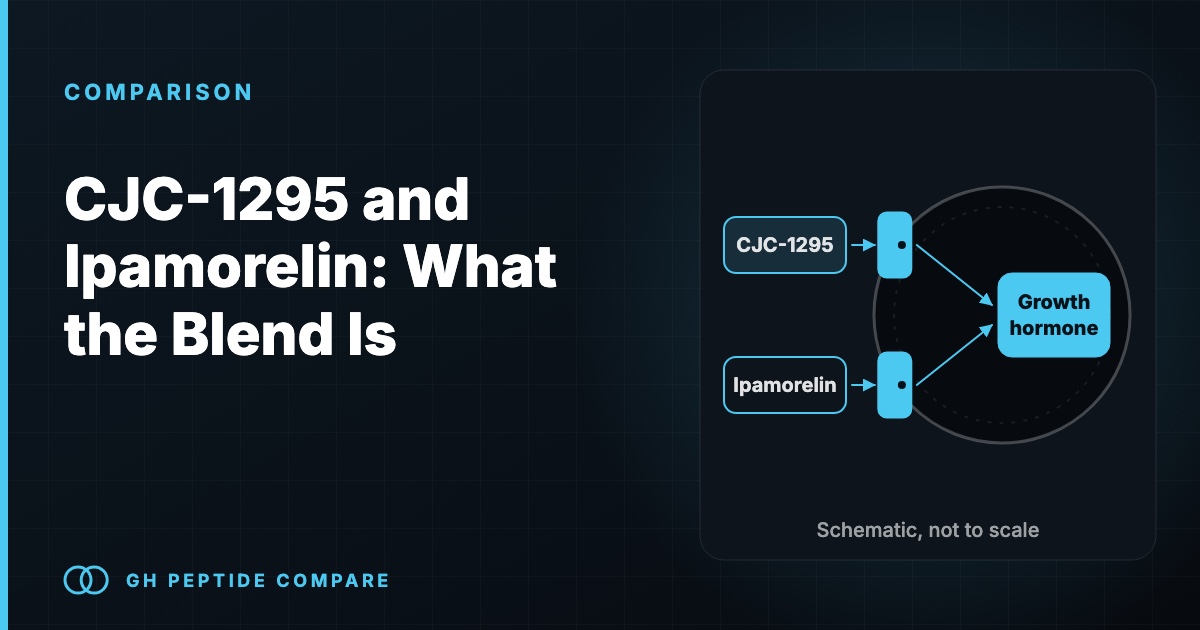
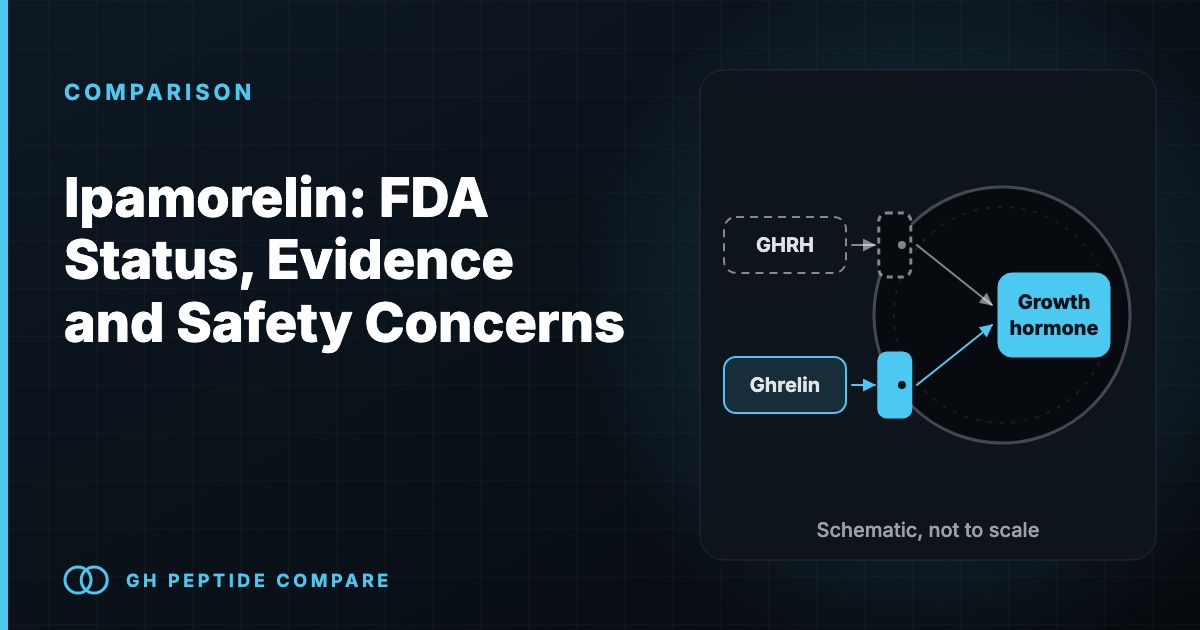
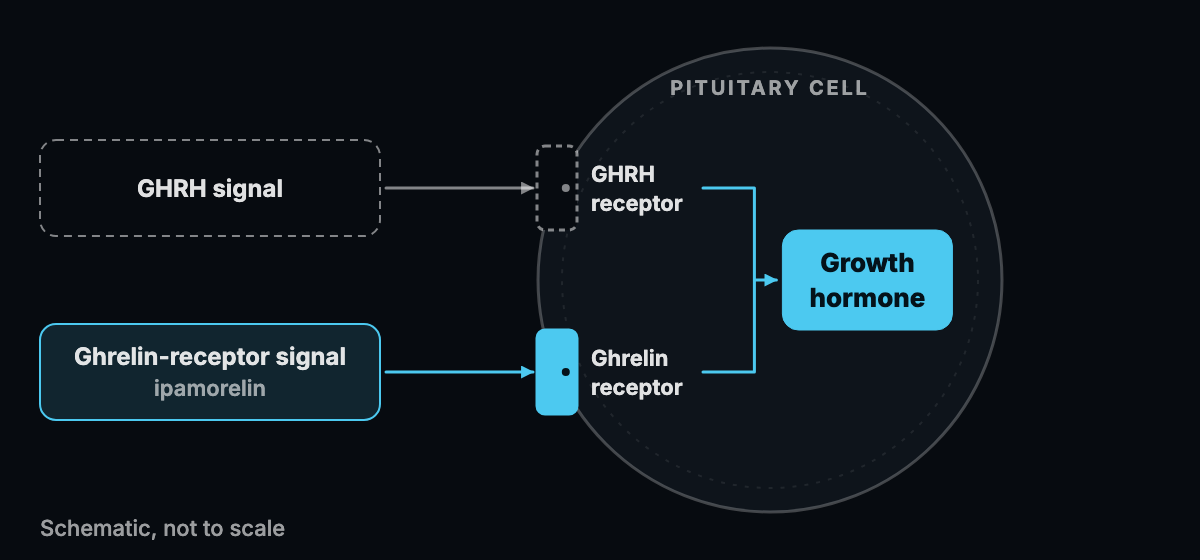
According to FDA's briefing for its compounding advisory committee (October 2024), ipamorelin is a synthetic pentapeptide that acts as a ghrelin mimetic. It works mainly by activating ghrelin receptors on GHRH-positive neurons in the hypothalamus, which stimulates growth hormone release from the anterior pituitary, and FDA says this happens without major effects on ACTH or cortisol. The briefing adds that some of the person's own pituitary growth hormone secretion must be preserved for ipamorelin to raise circulating levels.
The discovery paper (Raun 1998) reported in animals that ipamorelin, like GHRP-6, stimulates growth hormone release through a GHRP-like receptor, and that in swine it did not release ACTH or cortisol at doses far above those that released growth hormone. This is where the marketing line "more selective" comes from: a claim based on animal work. Sermorelin takes a different route; see sermorelin vs ipamorelin for the two-doors picture.
FDA status: never approved
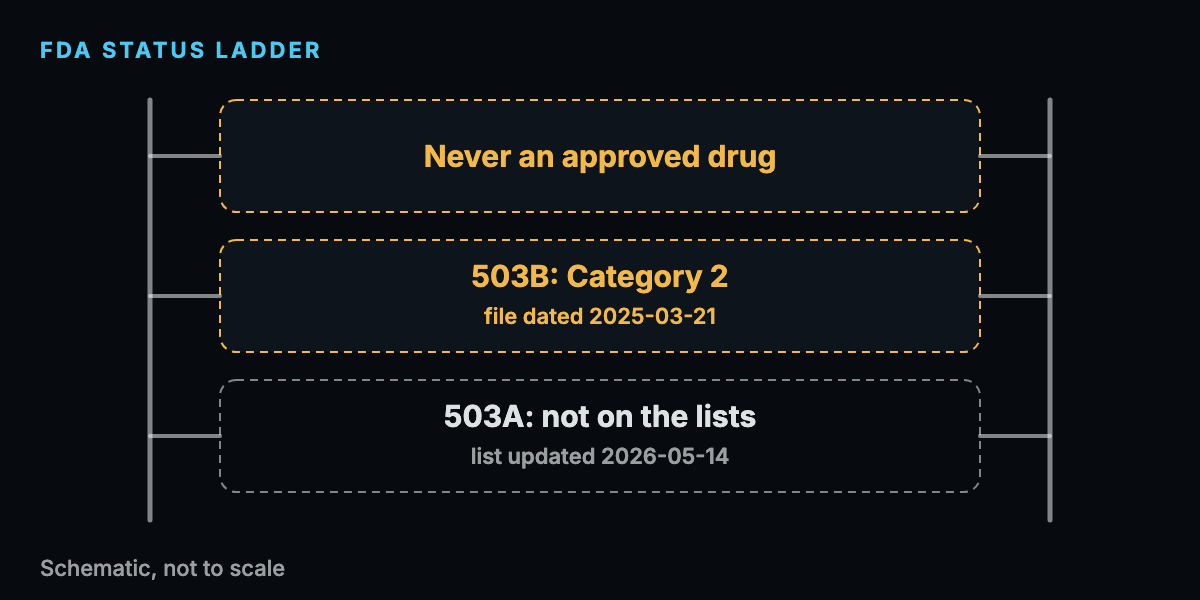
FDA's briefing states that there is no USP monograph for ipamorelin and that neither it nor its acetate form is a component of an FDA-approved drug. Our reading of the FDA documents, as of 2026-10-06:
- 503B (outsourcing facilities). FDA's category list, updated 2025-03-21, puts ipamorelin acetate in Category 2, defined by FDA as substances with significant safety risks identified, pending further evaluation. FDA's safety-risks page, current as of 2026-04-22, dates the listing 2023-09-29.
- 503A (pharmacies). Ipamorelin does not appear in any category on the list updated 2026-05-14. FDA's advisory committee voted 0 in favor and 12 against placing either form on that list on 2024-10-29, citing a lack of information supporting safety and efficacy. These votes are advisory. We found no statement in these documents on what that means for a pharmacy's legal position, so we make none.
- Compounded products are not FDA-approved. Category 2 is not a ban; it is a list status with the reasons FDA gives.
A newer 503B file than March 2025 may exist; we could not confirm either way.
What the human evidence is
FDA's briefing identified one human study relevant to growth hormone deficiency: a randomized, placebo-controlled dose-escalation study (Gobburu 1999) in 48 healthy men, in which ipamorelin was given as a 15-minute intravenous infusion. FDA says the study reported no effectiveness data on diagnosing or addressing growth hormone deficiency, and that it did not identify pharmacokinetic or pharmacodynamic information for subcutaneous injection, the route the nominators proposed. We did not open the original abstract; these details are FDA's description.
The other human trial is Beck 2014, a phase 2 study of intravenous ipamorelin after bowel surgery for postoperative ileus. It enrolled 117 hospitalized adults; median time to first tolerated meal was 25.3 hours with ipamorelin and 32.6 hours with placebo, a difference the abstract reports as not significant (p = 0.15). FDA quotes a later review saying development was discontinued after these disappointing results.
Two people in the ipamorelin group died. FDA's description is that both had bowel resection for colon cancer and developed postoperative complications. FDA writes that it is unclear whether the deaths were related to ipamorelin, but that their occurrence, together with higher rates of hypokalemia and hyperglycemia in the ipamorelin group, raises safety concerns about its use in compounding.
Safety statements as FDA words them
- Safety-risks page (current as of 2026-04-22). Compounded drugs containing ipamorelin acetate may pose risk for immunogenicity for certain routes because of potential aggregation or peptide-related impurities. It also contains unnatural amino acids, which add to the complexity of characterization. A published study found serious adverse events including death when ipamorelin was given intravenously for gastric motility. FDA says it has not identified safety information for certain other injectable routes, and so lacks sufficient information to know whether harm would result.
- Class concern in the briefing. Growth hormone secretagogues raise growth hormone and IGF-1, and FDA says the risks listed on approved growth hormone labels are a concern for ipamorelin too, including glucose intolerance and fluid retention.
- Nonclinical. FDA says ghrelin-receptor agonists may have behavioral reinforcing properties, an inference from the drug class rather than ipamorelin-specific studies or a human finding.
- Adverse-event reports. FDA's search found two non-serious reports to 2023-09-30, and said it could not assess a relationship to ipamorelin in either.
Warning letters and "research use only"
FDA's briefing says ipamorelin has been marketed for weight loss management, anti-aging, sleep and bodybuilding, increasingly by medical spas and wellness clinics. FDA warning letters of 2026-08-24 to NuScience Peptides and Royal Peptides name ipamorelin only inside tesamorelin blends: a "Tesamorelin Ipamorelin Blend" and a product called Bimorelin. Both letters say that labels reading research use only did not change FDA's finding that the products were intended as drugs for human use, based on the sellers' own website claims and the peptide calculators they offered. We found no 2025 or 2026 letter we read that targets ipamorelin sold on its own, though that rests on a search, not a complete review. Read more on the blend page.
Who offers it
Whoosh does not offer ipamorelin, as read on its pages 2026-10-06; Whoosh offers compounded sermorelin, which is not FDA-approved. There is no Whoosh button on this page for that reason. See the Whoosh review or compare the two on the three-way table.
FAQ
Is ipamorelin FDA-approved?
No. FDA's briefing says neither ipamorelin nor its acetate form is a component of an approved drug.
Is ipamorelin banned?
FDA lists ipamorelin acetate in 503B Category 2 for stated safety risks. That is a list status, and the 503A advisory vote was non-binding. We do not describe it as a ban.
Has ipamorelin been studied in humans?
Yes, but FDA identified only intravenous data: a study in 48 healthy men with no effectiveness data reported, and an ileus trial of 117 patients.
What does ipamorelin do?
FDA describes it as stimulating growth hormone release by activating ghrelin receptors. Whether that produces any outcome clinics claim is not established in the human data FDA cites.
Is ipamorelin on the WADA list?
Yes. WADA's 2026 Prohibited List names ipamorelin in section S2, which applies at all times.
Sources
- FDA: PCAC briefing on ipamorelin, 2024-10-29 read 2026-10-06
- FDA: PCAC final summary minutes, 2024-10-29 read 2026-10-06
- FDA: 503B bulk drug substances category list, updated 2025-03-21 read 2026-10-06
- FDA: 503A bulk drug substances category list, updated 2026-05-14 read 2026-10-06
- FDA: bulk drug substances that may present significant safety risks read 2026-10-06
- Beck et al. 2014, ipamorelin ileus trial (PubMed 25331030) read 2026-10-06
- Raun et al. 1998 (PubMed 9849822) read 2026-10-06
- FDA warning letter: NuScience Peptides LLC, 2026-08-24 read 2026-10-06
- FDA warning letter: Royal Peptides LLC, 2026-08-24 read 2026-10-06
- WADA 2026 Prohibited List read 2026-10-06
Not medical advice. See the medical disclaimer.