Quick answer: HGH is human growth hormone itself. As an approved product it is somatropin, a prescription hormone with labelled indications. Sermorelin is a peptide that prompts the pituitary gland to release the body's own growth hormone. FDA says the Secretary of HHS has not authorized HGH use for anti-aging, bodybuilding or athletic enhancement. Sermorelin's brand approvals were withdrawn in 2009. Whoosh offers compounded sermorelin, which is not FDA-approved.
"Sermorelin vs HGH" is really a question about two different kinds of drug. One supplies the hormone. The other asks the pituitary to supply it. This page lays out what each document says about the two, using the same questions for both, and does not recommend either. For background, see the sermorelin profile and the hub page.
Sermorelin vs HGH at a glance
| Question | Sermorelin | HGH (somatropin) | Source |
|---|---|---|---|
| What is it? | A 29 amino acid analogue of GHRH that stimulates the pituitary to secrete GH | Recombinant human growth hormone, the hormone itself | Prakash and Goa; Genotropin label |
| Approved products today | None. Geref approval withdrawn effective 2009-06-18 | Yes; Genotropin and Norditropin, both first approved in the U.S. in 1987 | Federal Register 2013; labels |
| Labelled use, children | Geref vials: children with growth failure from idiopathic GH deficiency | Treatment of children with growth failure due to growth hormone deficiency (GHD), Prader-Willi syndrome, Small for Gestational Age, Turner syndrome, and Idiopathic Short Stature | Federal Register; Genotropin label |
| Labelled use, adults | None; FDA says no GH secretagogue is approved for adult GH deficiency | Treatment of adults with either adult onset or childhood onset GHD | FDA CJC-1295 briefing; Genotropin label |
| Route | Subcutaneous injection in the studies read | Subcutaneous | Same sources |
| FDA statement on anti-aging use | Not addressed by name in the documents read | The Secretary of HHS has not authorized any HGH use for anti-aging, bodybuilding or athletic enhancement | Import Alert 66-71 |
| Evidence in healthy older adults | Small GHRH 1-29 studies | A systematic review of 31 articles | Khorram 1997; Liu 2007 |
| Offered by Whoosh? | Yes, compounded, not FDA-approved | No somatropin appears among the products Whoosh lists | Whoosh sitemap pages |
Table as of 2026-10-06. Every row was read from the cited source on that date.
How each works
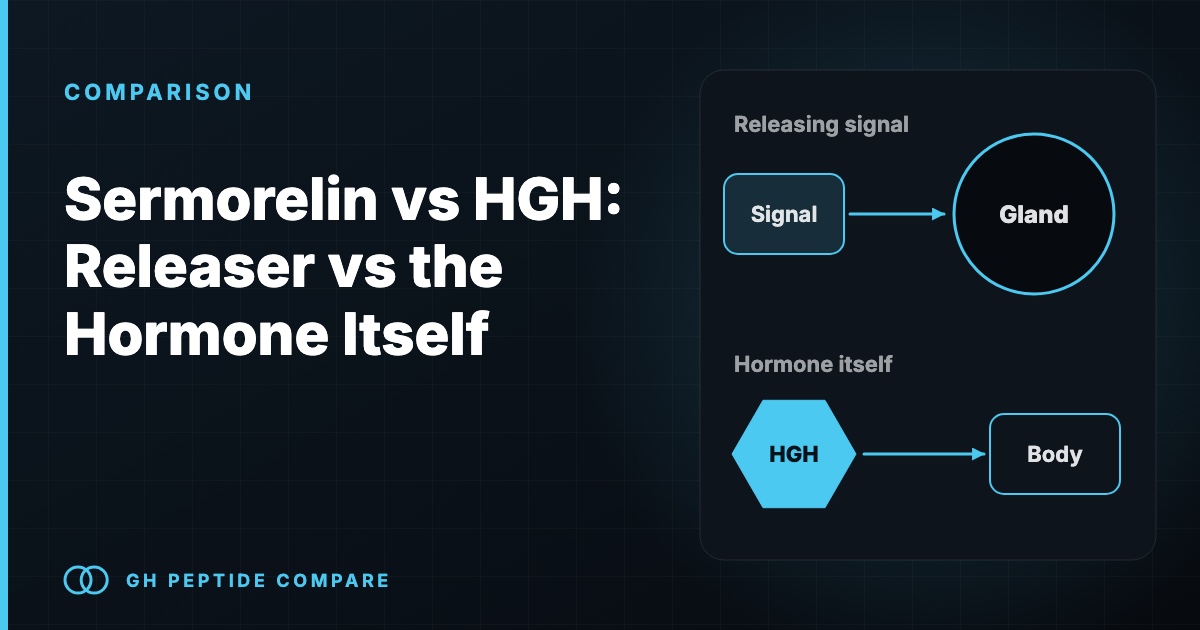
Somatropin is the hormone. The Genotropin label calls it a recombinant human growth hormone and gives it by subcutaneous injection. The body's tissues receive it directly, and the pituitary does not have to do anything.
Sermorelin works one step earlier. A published review describes it as a 29 amino acid analogue of growth-hormone-releasing hormone that specifically stimulates GH secretion from the anterior pituitary. The pituitary does the releasing. That is the whole conceptual difference, and the rest of this page is about what follows from it. For how sermorelin compares with the other releasing peptides, see sermorelin vs tesamorelin vs ipamorelin.
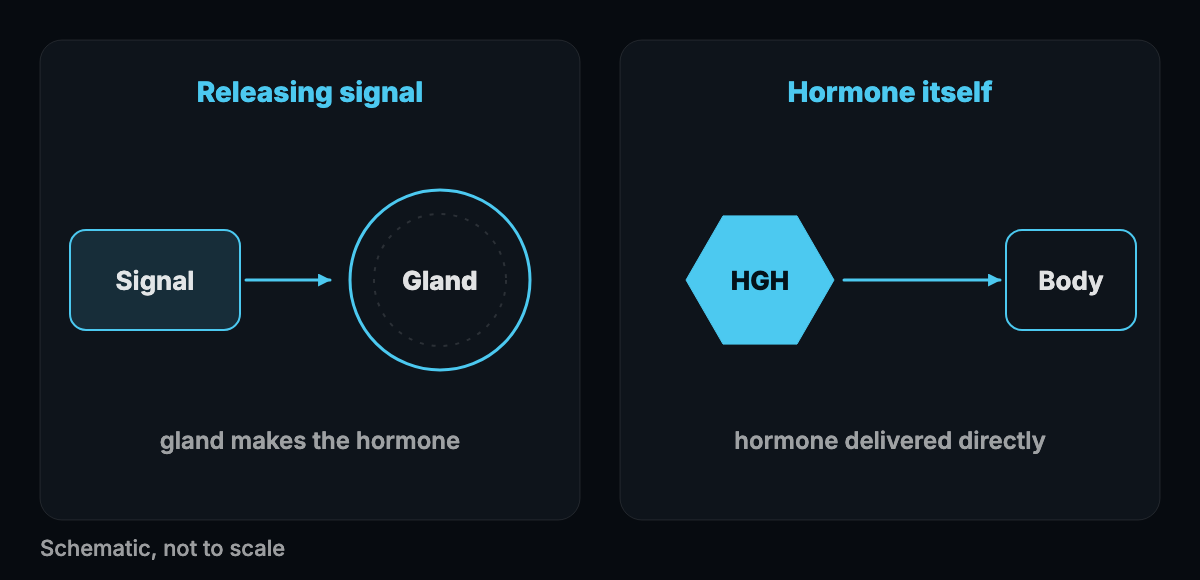
Releaser vs hormone
HGH is somatropin, an approved prescription hormone. The Genotropin label (Pfizer) and the Norditropin label (Novo Nordisk) both give 1987 as the year of first U.S. approval. Their indications are specific. For Norditropin, the adult indication reads Replacement of endogenous GH in adults with growth hormone deficiency. The Genotropin label defines the adults it covers by two criteria, adult-onset and childhood-onset deficiency. An Endocrine Society guideline on adult GH deficiency (Molitch 2011) adds that confirmation through stimulation testing is usually required. None of that describes a healthy adult.
Sermorelin prompts the pituitary. FDA's December 2024 briefing on CJC-1295 states that, among growth hormone secretagogues, only sermorelin (Geref) was approved, for short stature associated with GH deficiency in pediatric patients, and that no secretagogue has been approved for adult or childhood-onset GH deficiency in adults. A published review of sermorelin in children reports that height-velocity gains were less than those in children receiving once-daily somatropin, and that the effects of the recommended sermorelin regimen had not been directly compared with somatropin. In other words, even in the population Geref was approved for, the sources do not describe the two as interchangeable.
What a releaser might change about risk. A 2018 review by Sigalos and Pastuszak says secretagogues promote pulsatile GH release subject to negative feedback, which the authors say can keep GH from reaching supra-therapeutic levels. The same abstract says few long-term, rigorously controlled studies exist and notes concern about higher blood glucose from reduced insulin sensitivity. FDA's ipamorelin briefing adds that secretagogues raise GH and then IGF-1, and that the risks on every approved somatropin label are a concern for the class. These are reviewers' and FDA's statements, not findings from a trial comparing the two approaches.
The law and FDA's statement on HGH. Under 21 U.S.C. 333(e), as we read the statute on the Cornell LII site, knowingly distributing or possessing with intent to distribute human growth hormone for any human use other than one authorized under section 355 and ordered by a physician is an offense punishable by up to five years in prison. The statute defines HGH as somatrem, somatropin, or an analogue of either. The text we read does not say whether a GH secretagogue counts as an analogue, so this page makes no claim either way. FDA's Import Alert 66-71 (revision dated 2026-04-07) says pharmacies promote compounded HGH products for anti-aging, and states: "HGH is not approved by FDA for any of these uses." It adds: "The Secretary of HHS has not authorized, for example, any HGH use for anti-aging, bodybuilding, or athletic enhancement." The Federal Trade Commission's consumer page says even the prescription form of HGH has not been approved for anti-aging uses.
Sermorelin's own status. Geref's two approvals were withdrawn effective 2009-06-18 after the maker notified FDA of discontinuation in 2008; a 2013 notice says this was not for reasons of safety or effectiveness. Pharmacy-made sermorelin is compounded, which means it is not FDA-approved. On FDA's 503B list sermorelin acetate sits in Category 1, marked as a component of an approved drug, and it is not on any category of the 503A list updated 2026-05-14. The timeline is on is sermorelin FDA-approved.
What the human evidence is
HGH in healthy older adults. Liu and colleagues (Annals of Internal Medicine, 2007; PubMed 17227934) reviewed 31 articles covering 18 unique study populations. A total of 220 participants received GH, equal to 107 person-years; mean age was 69, mean BMI 28 and mean duration 27 weeks. Compared with no GH, fat mass changed by -2.1 kg (95% CI -2.8 to -1.35), lean body mass by 2.1 kg (CI 1.3 to 2.9; P < 0.001) and weight by 0.1 kg (CI -0.7 to 0.8; P = 0.87). Participants given GH were significantly more likely to have soft tissue edema, arthralgias, carpal tunnel syndrome and gynecomastia, and somewhat more likely to develop diabetes or impaired fasting glucose. The authors concluded GH "cannot be recommended as an antiaging therapy." Their background notes it has not been approved by FDA for that use. A separate 2008 review by Liu and colleagues of 303 young, lean participants found lean body mass rose by 2.1 kg while strength and exercise capacity did not seem to improve, and said claims that GH enhances physical performance are not supported by the scientific literature.
GHRH analogs in healthy older adults. The adult studies used GHRH 1-29 peptides, not a product named sermorelin in the abstracts. Khorram and colleagues (1997) gave 10 women and 9 men aged 55 to 71 saline for 4 weeks and then [Nle27]GHRH-(1-29)-NH2 for 16 weeks. Nocturnal GH rose in both sexes; body weight and blood pressure were unaffected; lean body mass rose in men only; skin thickness rose in both; and transient hyperlipidemia was the only adverse side effect reported. In Vittone's 1997 study of 11 men aged 64 to 76, run for six weeks, nocturnal GH release rose, IGF-I did not change, two of six strength measures improved, and weight and scan-measured muscle and fat were unchanged. Neither study compared a GHRH peptide with somatropin.
| Claim as marketed | Who says it | What supports it | Grade |
|---|---|---|---|
| HGH reverses aging | Anti-aging clinics, per FDA's import alert | Liu 2007: small body composition changes, more adverse events; FDA says no authorized anti-aging use | NO PUBLISHED DATA |
| HGH adds lean mass | Clinic and sport sources | Liu 2007 and 2008: lean mass rose by 2.1 kg; weight and strength not shown to improve | STUDIED IN HUMANS |
| Somatropin has labelled uses | Pfizer and Novo Nordisk labels | Genotropin and Norditropin labels | APPROVED LABEL |
| Sermorelin gives the same result as HGH with the pituitary in charge | Clinic pages | No head-to-head study in our sources; a pediatric review says none exists for the recommended regimen | NO PUBLISHED DATA |
| Sermorelin raises GH in older adults | Clinic pages | Small GHRH 1-29 studies, nocturnal GH up | STUDIED IN HUMANS |
Safety statements as reported
The Genotropin label lists warnings for acute critical illness, Prader-Willi syndrome, neoplasms, impaired glucose tolerance and diabetes mellitus, intracranial hypertension, severe hypersensitivity, fluid retention, hypoadrenalism, hypothyroidism, slipped capital femoral epiphysis, scoliosis progression, lipoatrophy and pancreatitis. Its contraindications include active malignancy and acute critical illness. In clinical trials in 1,145 adults with GH deficiency, most adverse events were mild to moderate symptoms of fluid retention, including peripheral swelling, joint pain and stiffness. FDA's import alert states that among the possible long-term side effects of HGH is an increased risk of cancer.
For sermorelin, no label warnings can be quoted here, because Geref's label was unavailable in every database we tried. A pediatric review lists transient facial flushing and pain where the injection was given as the events reported most often. See sermorelin side effects.
Who offers what
Whoosh offers compounded sermorelin, which is not FDA-approved; read the Whoosh Wellness sermorelin review. As stated by Whoosh, read 2026-10-06, a licensed physician decides whether a prescription is appropriate. Somatropin appears nowhere in the product list we read on Whoosh's pages. We print no price, because Whoosh's own pages disagree with one another.
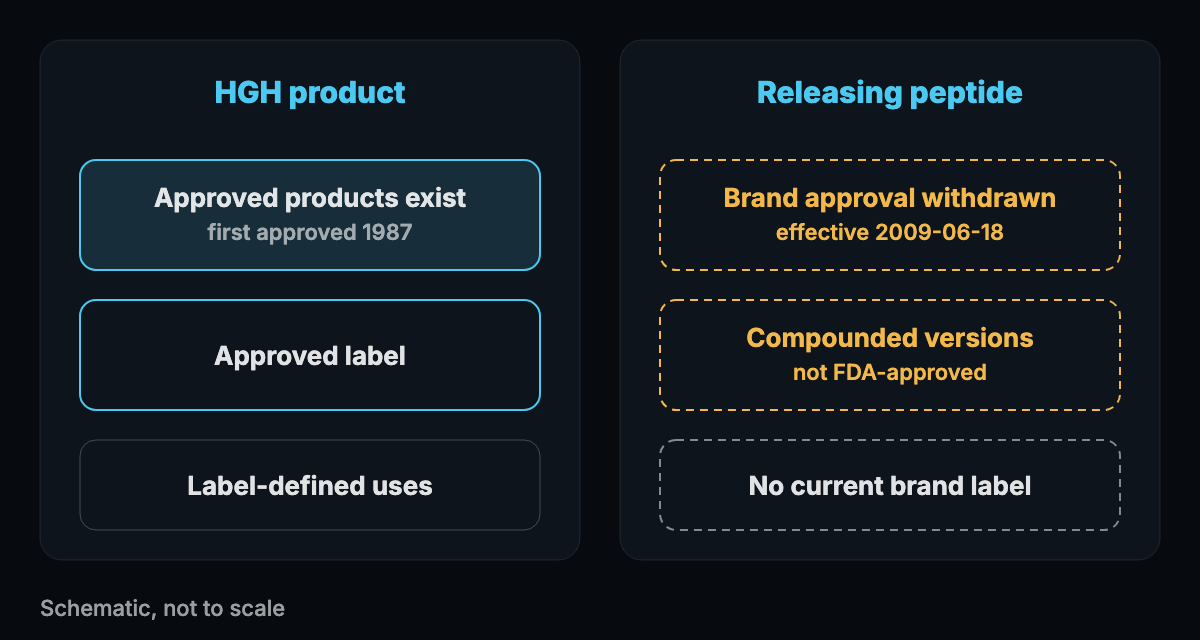
Which question are you asking?
| Situation | What the sources say | Page to read |
|---|---|---|
| I want to know if sermorelin is "HGH" | No. It prompts the pituitary; HGH is the hormone, as somatropin | This page |
| I want to know what FDA says about HGH for anti-aging | HHS has not authorized any such use | This page |
| I want sermorelin's approval history | Brand approved, then withdrawn in 2009 | Is sermorelin FDA-approved? |
| I want to know about weight | GHRH 1-29 studies reported weight unchanged | Sermorelin for weight loss |
| I want questions for a prescriber | A one-page list | Checklist |
FAQ
Is sermorelin HGH?
No. HGH is growth hormone itself, sold as somatropin. Sermorelin is an analogue of GHRH, the hormone that cues the pituitary to release GH.
Is HGH legal for anti-aging?
FDA says HGH is not approved for anti-aging and that the Secretary of HHS has not authorized any such use. 21 U.S.C. 333(e) covers distribution for uses not authorized and ordered by a physician. Ask a licensed physician about your own situation.
Did a study compare sermorelin with HGH in adults?
None appears in the sources we read. A pediatric review says the recommended sermorelin regimen had not been directly compared with somatropin.
Why did Geref leave the market?
The maker notified FDA of discontinuation in 2008, and FDA's withdrawal took effect 2009-06-18. A 2013 notice says it was not withdrawn from sale for reasons of safety or effectiveness.
Does a releaser carry the same warnings as somatropin?
The sources do not say so directly. FDA says it is concerned about similar risks for secretagogues because they raise GH and IGF-1, and a 2018 review says evidence on long-term safety is lacking.
Can I get HGH through Whoosh?
We found no somatropin product on Whoosh's pages. Whoosh offers compounded sermorelin, which is not FDA-approved.
Sources
- Genotropin label, DailyMed read 2026-10-06
- Norditropin label, DailyMed read 2026-10-06
- FDA Import Alert 66-71 read 2026-10-06
- 21 U.S.C. 333, Cornell LII read 2026-10-06
- FTC: anti-aging products read 2026-10-06
- Liu et al. 2007 (PubMed 17227934) read 2026-10-06
- Liu et al. 2008 (PubMed 18347346) read 2026-10-06
- Khorram et al. 1997 (PubMed 9141536) read 2026-10-06
- Vittone et al. 1997 (PubMed 9005976) read 2026-10-06
- Prakash and Goa 1999 (PubMed 18031173) read 2026-10-06
- Sigalos and Pastuszak 2018 (PubMed 28400207) read 2026-10-06
- Molitch et al. 2011 (PubMed 21602453) read 2026-10-06
- FDA PCAC briefing on CJC-1295, 2024-12-04 read 2026-10-06
- FDA PCAC briefing on ipamorelin, 2024-10-29 read 2026-10-06
- Federal Register 78 FR 14095, 2013-03-04 read 2026-10-06
- FDA 503B category list, updated 2025-03-21 read 2026-10-06
- FDA 503A category list, updated 2026-05-14 read 2026-10-06
- Whoosh Wellness sitemap read 2026-10-06
Not medical advice. See the medical disclaimer.