Quick answer: "CJC-1295 with ipamorelin" is a combination sold online that pairs a growth-hormone-releasing-hormone analog with a ghrelin-receptor agonist. Neither ingredient is an FDA-approved drug. FDA's advisory committee voted against adding either to a pharmacy compounding list, and FDA has made no finding that the pair works better together. Human evidence exists for each part separately, and none for the two combined.
| Fact | What the sources say |
|---|---|
| Class and receptor | CJC-1295 is described by FDA as a 29-amino-acid analogue of growth-hormone-releasing hormone; ipamorelin is described by FDA as a ghrelin mimetic |
| FDA status | Neither is a component of an approved drug, per FDA's 2024 briefing documents |
| Route as described in sources | Both were evaluated by FDA as injections under the skin; the human ipamorelin data FDA found were intravenous |
| Whoosh offers this | No |
What the blend is
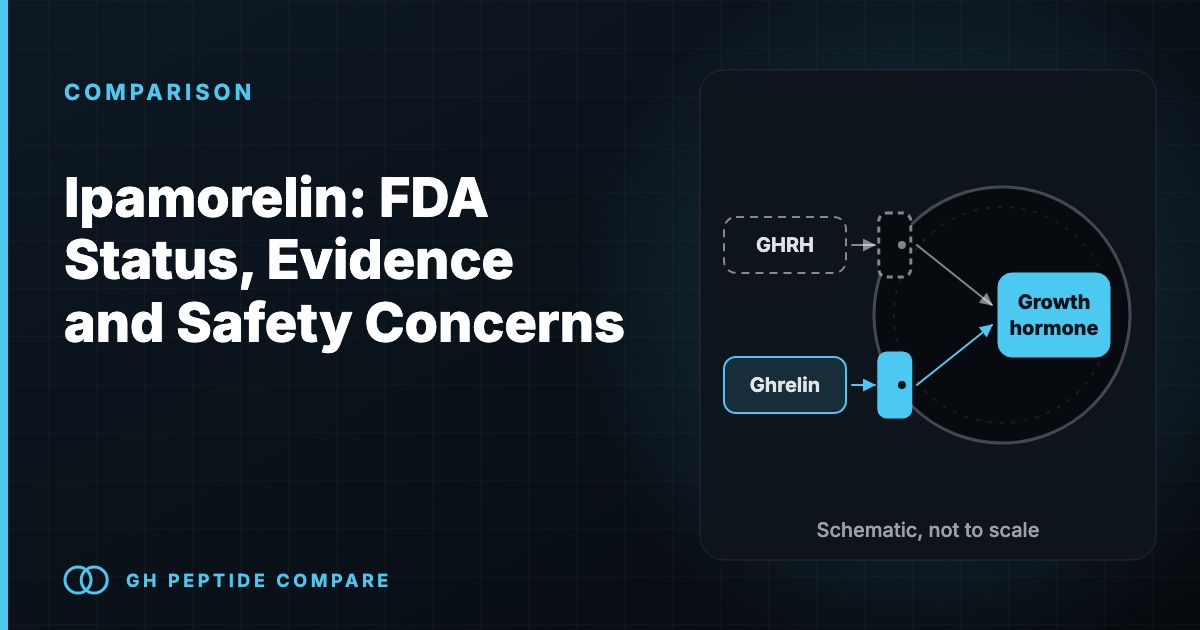
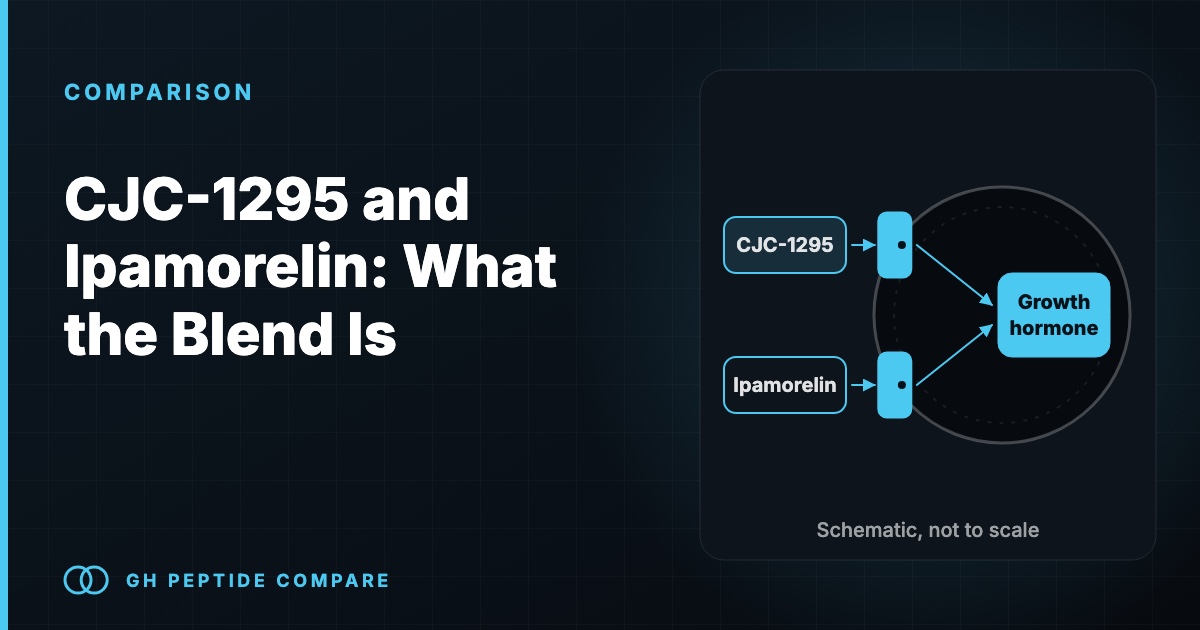
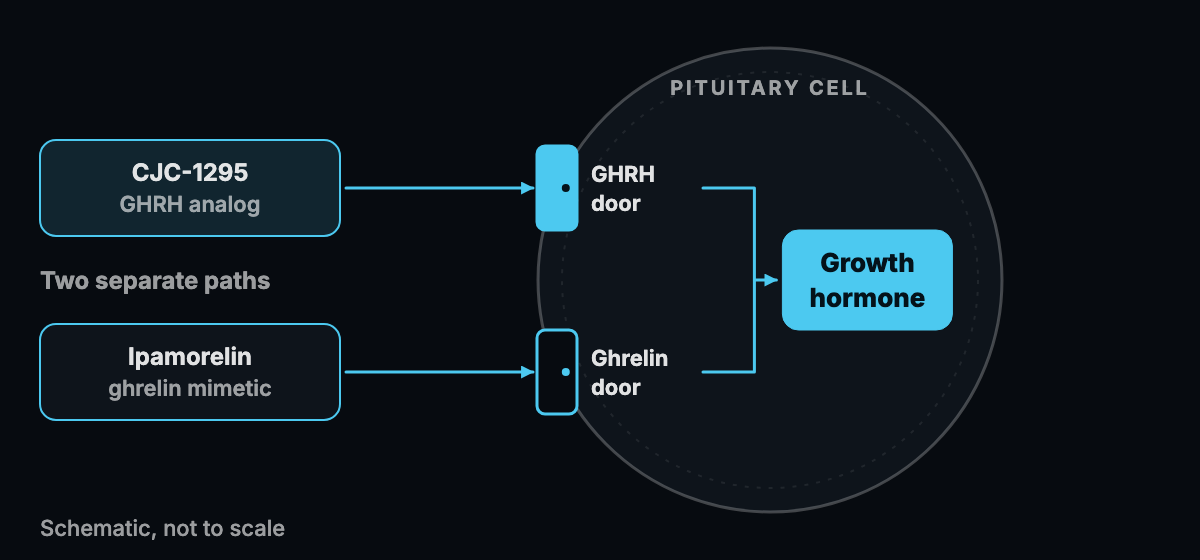
Two different signals reach the pituitary gland, and each ingredient uses one of them. CJC-1295, according to FDA's December 2024 briefing, is a synthetic analogue of the natural hormone that tells the pituitary to release growth hormone. Ipamorelin, according to FDA's October 2024 briefing, activates ghrelin receptors and stimulates growth hormone release without major effects on cortisol or ACTH.
So the blend combines one peptide from each family. Websites that sell it, FDA reports, describe the two as working "synergistically." That word is relayed marketing. FDA's briefing quotes it as a website claim and as the comment of one outside expert who did not say which form of CJC-1295 they meant. Neither is a finding.
What FDA says about each part
CJC-1295. FDA's briefing for its December 4, 2024 advisory meeting covers five forms: the free base, an acetate salt, and three versions of CJC-1295 with a "drug affinity complex" (DAC). FDA states that none of the five is a component of an FDA-approved drug and that no studies gave any form of CJC-1295 to people with a disease or condition. Its safety page lists serious adverse events associated with CJC-1295, including increased heart rate and a systemic vasodilatory reaction, and says available clinical data are limited.
Ipamorelin. FDA's briefing for its October 29, 2024 meeting says there is no USP monograph for ipamorelin and that it is not a component of an approved drug. The briefing found one human pharmacology study in healthy men, given by short intravenous infusion, with no effectiveness data. On FDA's 503B list for outsourcing facilities (updated March 21, 2025), ipamorelin acetate sits in Category 2, significant safety risks pending further evaluation. FDA's safety page dates that placement to September 29, 2023. CJC-1295 does not appear in that 503B file. Our ipamorelin profile has the full status.
The advisory votes
The Pharmacy Compounding Advisory Committee advises FDA; its votes are not final decisions. Per FDA's final summary minutes:
| Meeting | Question | Result |
|---|---|---|
| 2024-10-29 | Place ipamorelin (free base) on the 503A bulks list | Yes 0, No 12, Abstain 1 |
| 2024-10-29 | Place ipamorelin acetate on the 503A bulks list | Yes 0, No 12, Abstain 1 |
| 2024-12-04 | CJC-1295 free base | Yes 0, No 13 |
| 2024-12-04 | CJC-1295 acetate | Yes 1, No 12 |
| 2024-12-04 | Each of three CJC-1295 DAC forms | Yes 0, No 13 |
The committee reviewed these for growth hormone deficiency (and, for ipamorelin, postoperative ileus). The minutes give the reason for ipamorelin as a lack of information supporting safety and efficacy. The 503A category list updated May 14, 2026 does not name either peptide.
The only thing FDA says about the blend
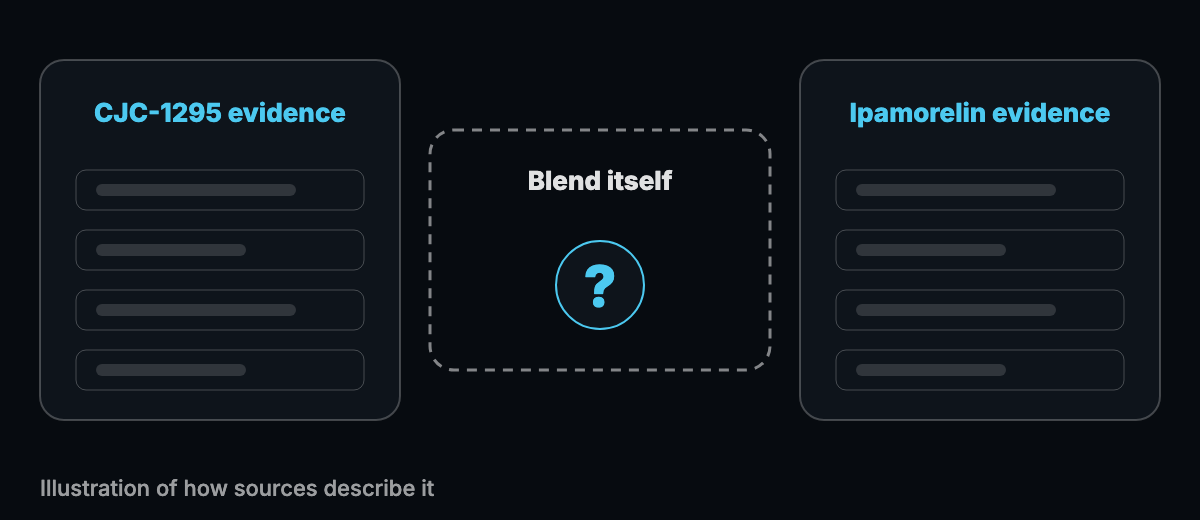
A footnote in FDA's CJC-1295 briefing records that a single outsourcing facility made a combined injection of the two peptides during 2019 and 2020, and that none has reported making CJC-1295 products after 2020. That describes a past product, not a review of whether it works.
The 2006 trial death
According to FDA's briefing, the developer ConjuChem pulled CJC-1295 DAC out of clinical trials in 2006, following the death of one participant in a phase 2 study. The detail comes from two internet news reports, not peer-reviewed literature. They describe a participant with HIV lipodystrophy who reported chest discomfort after a weekly injection, was found by ECG to be having a heart attack, and died about an hour later. The attending physician's most likely explanation, as the reports relay it, was undiagnosed coronary artery disease with plaque rupture. The study was ended and its data have not been published.
We cannot say what role, if any, the drug played, and nothing in the sources says CJC-1295 caused the death. What the sources support is narrower: a death occurred in a trial, and the full data were never made public.
What the human evidence is
For CJC-1295 with DAC, FDA identified three published studies, all in healthy volunteers: Ionescu and Frohman 2006, Teichman 2006 and Sackmann-Sala 2009. Per FDA, 63 healthy adults, 87% men, received up to four injections in total. The Teichman abstract describes two placebo-controlled trials in healthy adults in which a single injection raised growth hormone and IGF-I, with an estimated half-life of 5.8 to 8.1 days and no serious adverse reactions reported. FDA lists injection-site reactions, flushing and warmth, headache, nausea and increased heart rate among the effects seen in healthy subjects, and says long-term safety in humans is unknown.
One popular line is that the DAC attachment is what makes CJC-1295 last longer in the body. FDA's wording is that this is a hypothesis, and that showing it would need a demonstration that the half-life with DAC is longer than without it. FDA found no human half-life for the version without DAC, so the claim is unproven on the record we read.
For ipamorelin, the human data FDA found are intravenous: a pharmacology study in healthy men and a phase 2 trial in hospitalized adults after bowel surgery. That trial missed its main endpoint, and two participants who received ipamorelin died; FDA says it is unclear whether the deaths were related to the drug.
Evidence for one component cannot be carried to the pair. A result seen with one peptide says nothing certain about what happens when two different receptor signals are given together, and no study we found tested the pair.
Marketing claims FDA names
FDA's briefings say CJC-1295 is marketed online for weight loss, muscle building and anti-aging, and ipamorelin for similar purposes. The sermorelin vs CJC-1295 page sets such claims against their sources. FDA warning letters dated 2026-08-24 named products sold as research peptides unapproved new drugs.
Who offers it
Whoosh does not offer CJC-1295, ipamorelin or the blend. As stated by Whoosh, read 2026-10-06, its service offers compounded sermorelin through a licensed physician, and compounded medications are not FDA-approved. See the Whoosh Wellness sermorelin review for what it states and does not state. A licensed physician decides whether any prescription is appropriate.
FAQ
Is CJC-1295 with ipamorelin FDA-approved?
No. FDA's briefings state that neither ingredient is a component of an FDA-approved drug. Any version sold by a pharmacy would be compounded and not FDA-approved.
Do the two peptides work synergistically?
That is how some websites describe it. FDA's briefing relays the claim and attributes it to websites and one outside expert; it makes no finding. We found no human study of the pair.
Did CJC-1295 cause a death in a 2006 trial?
The sources do not say so. Two internet news reports, relayed by FDA, say a participant died after a heart attack, that the physician pointed to coronary artery disease, and that the data were never published.
Did the advisory committee ban either peptide?
No. The committee voted against adding each to a 503A list, and its votes are advisory. FDA decides, and the committee's reasoning concerned limited safety and efficacy information.
Is the blend the same as tesamorelin?
No. Tesamorelin is an FDA-approved growth-hormone-releasing factor analog with one narrow labelled use. See the tesamorelin profile.
Sources
- FDA briefing document, CJC-1295, PCAC December 4, 2024 read 2026-10-06
- FDA briefing document, ipamorelin, PCAC October 29, 2024 read 2026-10-06
- FDA final summary minutes, October 29, 2024 read 2026-10-06
- FDA final summary minutes, December 4, 2024 read 2026-10-06
- FDA: certain bulk drug substances that may present significant safety risks read 2026-10-06
- FDA 503B category list, updated March 21, 2025 read 2026-10-06
- FDA 503A category list, updated May 14, 2026 read 2026-10-06
- Teichman et al. 2006, PubMed 16352683 read 2026-10-06
- FDA warning letter, Royal Peptides LLC, 2026-08-24 read 2026-10-06
Not medical advice. See the medical disclaimer.