Quick answer: Results posts shared online cannot show what sermorelin does, because they have no comparison group and the people who post them chose to. The few controlled studies of GHRH-(1-29) peptides in adults measured hormone levels, some body-composition outcomes and questionnaires: body weight was unchanged in both studies that reported it, and lean mass rose in men only in one. Compounded sermorelin is not FDA-approved. This page has no photos and no personal stories on purpose.
You may have arrived here because you saw a post that promised a visible change from a sermorelin product, or because you wanted to know whether such posts mean anything. This page takes the second question seriously. It explains why a before-and-after claim is weak evidence, summarizes what controlled studies of growth-hormone-releasing peptides measured, and then lays out a ledger of common marketing claims with what supports each one. You will not find images of bodies, personal accounts or quotations from customers here, because none of those can answer the question.
A note on how this site earns money: some links on this page are affiliate links to Whoosh Wellness, and we may earn a commission when a reader uses them. The ledger below handles Whoosh's own statements the same way it handles everyone else's.
Why before-and-after claims are weak evidence
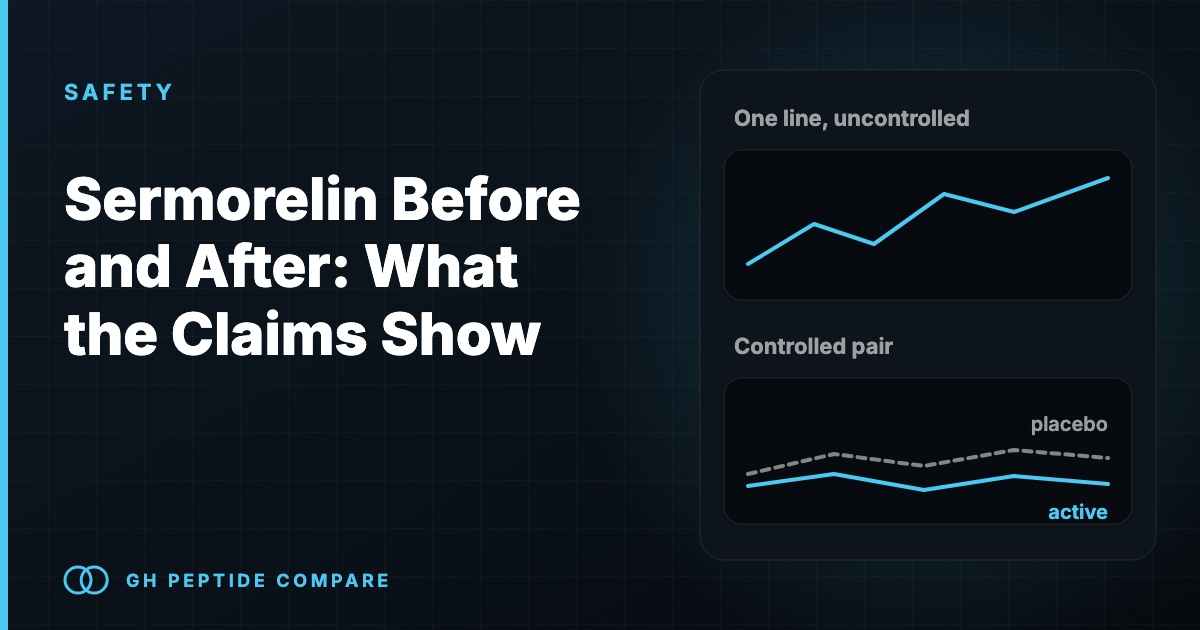
A before-and-after comparison feels persuasive because the difference is visible, but it is weak evidence. The trouble is that a difference over time is not the same thing as an effect of the thing being sold. Several well-known problems stand between a results post and a conclusion.
There is no control. Bodies change anyway. Weight, sleep and energy all move up and down without any product. A single person's series of photos or numbers cannot say what would have happened without the product, and that is the only question that matters.
Regression to the mean. People tend to start something when they feel at their worst, whether that is a low-energy month, a weight peak or a poor stretch of sleep. Almost anything measured at an extreme moves back toward average later. That return looks like improvement and would have occurred without any intervention.
Placebo and expectation. Someone who pays for a product and expects a change reports and perceives changes more readily. Sleep quality and energy are especially sensitive to this, because they are self-rated.
Selection of who posts. Results shared online come from people who were pleased enough to share. Those who saw nothing, stopped, or had a problem mostly do not post. The visible sample is the successes, so it cannot tell you how common success is.
Everything else changes too. A person who begins a product often also starts exercising, changes what they eat, adjusts other medications or begins a different wellness routine. A before-and-after claim attributes the whole change to one input.
Measurement is uncontrolled. Lighting, posture, time of day, hydration and clothing alter a photo or a scale reading. In a controlled study, researchers fix those conditions. A results post does not.
Uncontrolled blinding. The person posting knows what they took and what they hope for. In a blinded study, neither the participant nor, in a double-blind design, the researcher knows who received the active product, which limits the pull of expectation.
The seller's incentive. A business that shows results is selecting them, and a business that gets paid when a reader signs up has a reason to feature the strongest. That is true of us too, which is why we show none.
None of this means anyone is lying. It means the format cannot answer the question. That is why researchers use controlled designs, and why the weight-loss page separates what was measured from what is claimed.
What controlled studies of GHRH peptides measured
The published human literature on sermorelin-type peptides in adults is small and mostly from the 1990s. A caution first: the abstracts we read describe a GHRH-(1-29) peptide or analog and do not all name sermorelin, so we describe them that way and do not call them sermorelin trials.
Khorram and colleagues, 1997. The Journal of Clinical Endocrinology and Metabolism published a single-blind, randomized, placebo-controlled study of 10 women and 9 men aged 55 to 71 over five months. Participants first received saline, then a GHRH-(1-29) analog. According to the abstract:
- Overnight growth hormone rose in both sexes, and IGF-I, a hormone the liver makes in response to growth hormone, rose too.
- Blood pressure and body weight were unaffected.
- Skin thickness increased in both sexes and lean body mass increased in men only, with no other body-composition or bone-density change in either sex.
- Insulin sensitivity improved in men only.
- Men, but not women, reported improvement in general well-being and libido. Sleep quality was unaffected in both sexes.
The authors wrote of anabolic effects favoring men more than women and called for further study of the gender differences.
Vittone and colleagues, 1997. Metabolism published a six-week study of 11 healthy, non-obese men aged 64 to 76 with low baseline IGF-I, using a GHRH-(1-29) peptide. The abstract does not describe a placebo arm. Overnight growth hormone release increased, but the abstract reports no change in IGF-I. Two of six strength measures and an abdominal endurance test improved. Weight, body mass index, waist-to-hip ratio, scan-measured muscle and fat, glucose, insulin and lipids did not change.
Corpas and colleagues, 1992. A 14-day study of older men reported that a higher exposure raised 24-hour growth hormone and IGF-I toward the levels seen in the young men studied alongside them. It measured no body-composition outcome.
Sigalos and colleagues, 2017. This was a retrospective chart review of 14 men who were also on testosterone and who took a three-peptide combination, not sermorelin alone. IGF-1 rose. The abstract reports no weight outcome. A chart review has no control group.
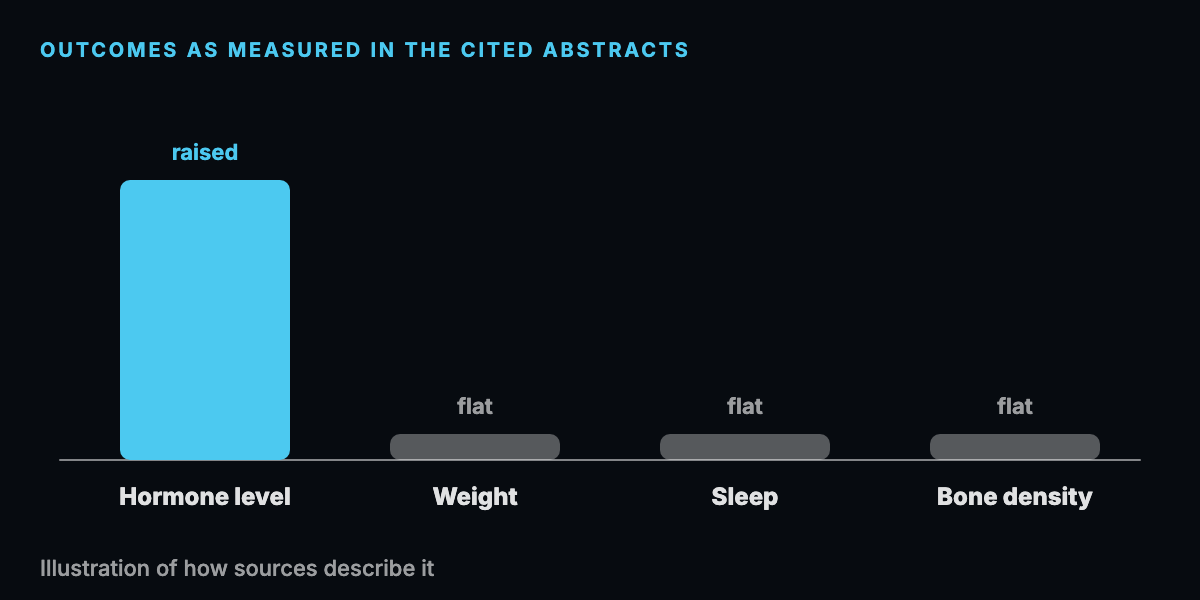
Put together, this evidence shows that these peptides raised growth hormone in the studied adults. It does not show that raising it produced lasting, visible changes, and the one review we found in this area, by Corpas and colleagues in Endocrine Reviews in 1993, said much more research would be needed to learn whether normalizing growth hormone and IGF-I in healthy older people improves function or quality of life. These were small groups, mostly men, followed for weeks to months. No trial we found reports weight loss with sermorelin or a GHRH-(1-29) peptide, though our search was not exhaustive.
Two points worth keeping in mind. First, a hormone level is a surrogate marker, a number that moves, and not itself a result a person would feel. Second, the one study that enrolled women found its body-composition and well-being effects in men only. The women page goes through who was in the studies.
The claim ledger
The table lists claims that appear in marketing for sermorelin products and what the sources we could verify say about each. Grades come from a fixed set: APPROVED LABEL, STUDIED IN HUMANS, ANIMAL OR LAB ONLY, NO PUBLISHED DATA. "Studied in humans" means a study measured something related, not that the claim held up. Quoted phrases are short and attributed. As of 2026-10-06.
| Claim as marketed | Who says it | What supports it | Grade |
|---|---|---|---|
| "Supports lean body composition goals" | Whoosh product page, as stated by Whoosh, read 2026-10-06 | Khorram reports lean body mass rose in men only, with no other body-composition change in either sex; Vittone reports no change in scan-measured muscle or fat | STUDIED IN HUMANS |
| Secretagogues "can improve body composition and help with fat loss" | Whoosh women's blog, as stated by Whoosh | No trial we opened reports fat loss; body weight was unaffected in Khorram and unchanged in Vittone; we found no primary trial in women backing the statement | NO PUBLISHED DATA |
| "Deeper, more restorative sleep" | Whoosh pricing page, as stated by Whoosh | Khorram measured sleep with questionnaires and reports sleep quality unaffected in both sexes; we found no sleep-lab study of sermorelin | STUDIED IN HUMANS |
| "May support post-training recovery" | Whoosh pricing and product pages | None of the abstracts we read measured recovery | NO PUBLISHED DATA |
| Improved energy, sleep, lean mass and vitality | USADA states that users report these, and that robust clinical evidence for anti-aging effects is lacking | User reports are not controlled data | NO PUBLISHED DATA |
| "Well-established clinical history" | Whoosh pricing page | Geref was approved by FDA in 1990 for a diagnostic use and in 1997 for children with growth failure, then discontinued by its maker in 2008; that history is pediatric and diagnostic, not about the wellness uses marketed today | APPROVED LABEL |
| Raises growth hormone and IGF-I | Common in seller material | Khorram and Corpas report rises in growth hormone and IGF-I; Vittone reports a rise in growth hormone release but no IGF-I change | STUDIED IN HUMANS |
| "Generally considered safer than direct HGH injections" | Whoosh blog; USADA uses similar wording about the release pattern | A pediatric review by Prakash and Goa states the recommended sermorelin regimen has not been directly compared with somatropin; no head-to-head adult comparison found | NO PUBLISHED DATA |
| "Every batch is third-party tested" | Whoosh, as stated by Whoosh | No laboratory, standard or certificate is named on the pages we read | NO PUBLISHED DATA |
| "Not a prohibited substance" | Whoosh blog | WADA's 2026 Prohibited List names sermorelin among prohibited growth hormone releasing factors | CONTRADICTED BY SOURCE |
Two things to notice. The strongest-supported rows are about hormone levels, which is where the evidence is. The claims that matter most to a buyer, weight, recovery and sleep, are the ones with the least support. For more on side-effect reporting, see what sources report about side effects.
How to read a results post shared online
When you see one, ask these questions, in order.
- What else changed? Look for diet, training, a new medication or a long period of ill health that ended.
- What was measured, and how? A scale reading, a photo or a blood level are different things. A blood level of a hormone is not a change in how someone looks or feels.
- Is there a comparison? One person over time is a story. A group compared with a placebo group is a study.
- Who benefits if you believe it? If the post links to a seller, the author may be paid when you click.
- How were the cases chosen? A feed shows what people chose to show.
- What product is it? A GHRH-(1-29) peptide in a study, a compounded preparation from a pharmacy and a vial sold online with a laboratory-use warning, which is a warning and not a form of approval are three different things. Sermorelin from a compounding pharmacy is not FDA-approved.
The questions checklist turns this into questions for a prescriber.
Where a prescriber fits
If the studies leave you with questions rather than answers, that is a reasonable place to be. A licensed physician decides whether a prescription is appropriate, and a good conversation includes what is known, what is not, and what would be monitored.
Whoosh states that a licensed doctor reviews each intake individually and that completing the questionnaire does not guarantee a prescription. If you want to see what the service asks, the button below goes to its intake. A licensed physician decides whether a prescription is appropriate, and nothing here implies any result.
Sources
- PubMed: Khorram, Laughlin and Yen, J Clin Endocrinol Metab 1997 read 2026-10-06
- PubMed: Vittone et al., Metabolism 1997 read 2026-10-06
- PubMed: Corpas et al., J Clin Endocrinol Metab 1992 read 2026-10-06
- PubMed: Corpas, Harman and Blackman, Endocrine Reviews 1993 read 2026-10-06
- PubMed: Sigalos et al., Am J Mens Health 2017 read 2026-10-06
- PubMed: Prakash and Goa, BioDrugs 1999 read 2026-10-06
- Federal Register notice, 2013-03-04 read 2026-10-06
- USADA: What should athletes know about sermorelin read 2026-10-06
- WADA 2026 Prohibited List read 2026-10-06
- Whoosh Wellness: sermorelin product and pricing pages read 2026-10-06
FAQ
Why is a before-and-after photo not evidence that sermorelin works?
No. Photos taken over time cannot separate an effect of the product from ordinary change, expectation, selection of who posts and other changes in a person's life. A controlled design is needed for that.
Did any study show weight loss with sermorelin?
None that we found. Khorram reports body weight unaffected and Vittone reports no change in weight or body mass index, in GHRH-(1-29) peptide studies. Our search was not exhaustive.
What did the controlled studies actually find?
Growth hormone levels rose. In one placebo-controlled study, lean body mass rose in men only, and sleep quality, measured by questionnaire, was unaffected. Other outcomes were unchanged.
Why does this page have no photos or stories?
Because they cannot answer the question, and the partner's rules for this site rule out personal accounts and imagery of people. We would rather show what was measured.
Are the studies about the same product people buy now?
Not necessarily. They describe a GHRH-(1-29) peptide or analog in research settings, while a compounded product is prepared by a pharmacy, is not FDA-approved and has no label of its own.
Can a seller's claims be checked?
Partly. Ask which source supports the claim, who was studied and what was measured. The ledger above does this for common claims.
Not medical advice. See the medical disclaimer.