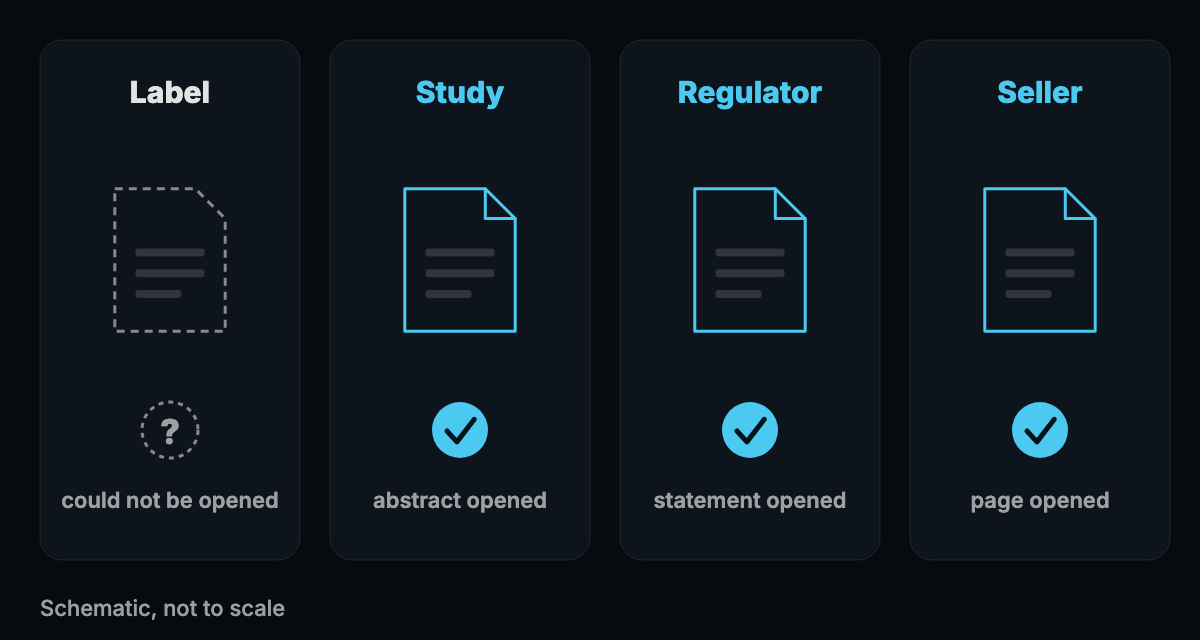
Quick answer: The published record on sermorelin side effects is thin and mostly old. A pediatric review reports transient facial flushing and pain at the injection site as the most commonly reported events, and small adult studies report few events. The brand label, Geref, could not be opened for this page, and compounded sermorelin is not FDA-approved and has no label of its own. Everything below is attributed to the source that says it.
Most pages that list sermorelin side effects blend four different kinds of evidence into one tidy list: a discontinued brand label, small academic studies, regulator statements and seller marketing. They are not equal, and they do not describe the same product. This page keeps them apart. For each effect we say who reported it, in whom, and over what period, and we say plainly where a source could not be reached. If you want the wider picture first, the sermorelin profile gives the basics, and the FDA history explains why the brand is gone.
Some links on this page are affiliate links, which means GH Peptide Compare may earn a commission from Whoosh Wellness if you use them. That does not change what the sources say, and it does not change what we leave out.
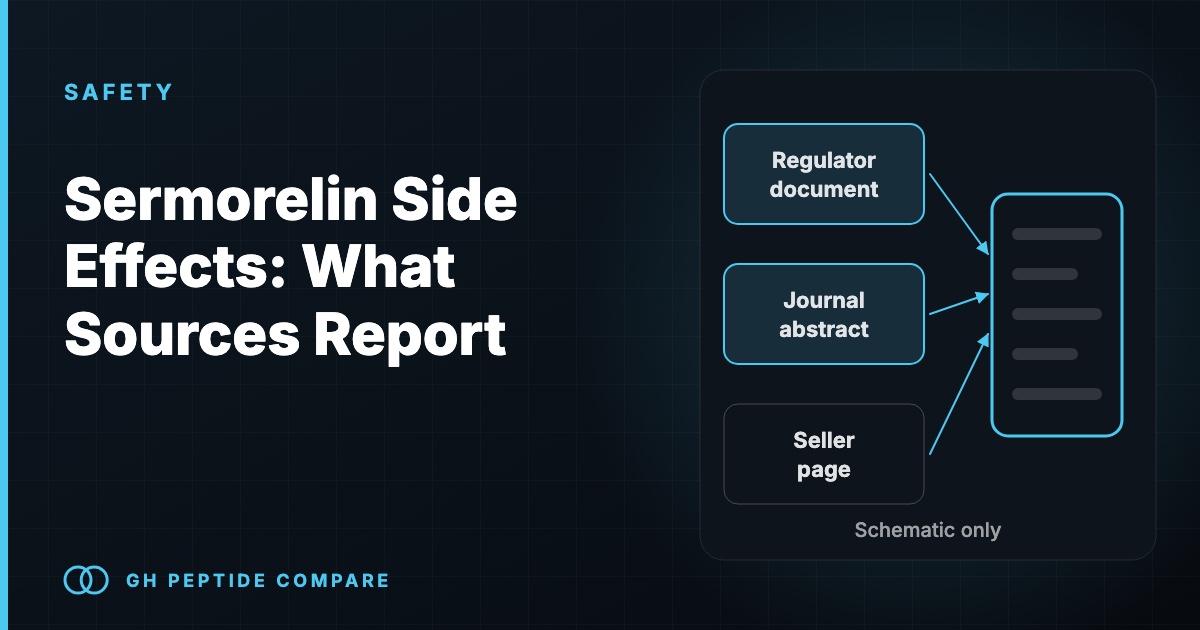
What kinds of sources list sermorelin effects
An approved label is a regulator-reviewed document for prescribers, with sections on adverse reactions and warnings. Sermorelin once had one, as Geref. A study abstract reports what happened to the people enrolled, for as long as they were followed. A regulator statement or recall notice says what FDA noticed about a category or a batch, and is not a rate of side effects. A seller page is marketing plus, sometimes, a safety paragraph written by someone with a reason to present the product favorably.
What the sources report
According to a 1999 review of sermorelin in children by Prakash and Goa, published in BioDrugs, "transient facial flushing and pain at injection site were the most commonly reported adverse events." That is the single clearest sentence about sermorelin side effects we could verify in a primary source, and it comes from a review of the pediatric growth-failure studies, not from studies of healthy adults using it for wellness.
In the multicenter pediatric study behind that review, led by Thorner for the Geref International Study Group in 1996, 110 previously untreated prepubertal children with growth hormone deficiency received a GHRH-(1-29) peptide for up to a year. The abstract reports no adverse changes in general biochemical or hormonal analyses and says the peptide was "well tolerated." We quote that phrase because it is the authors' own, in a children's population, in an open-label design with no placebo group. It is not our assessment, and it does not transfer to adults.
The adult studies are smaller still. The table below lists what each abstract says about adverse events.
| Study | Who was enrolled | What the abstract says about adverse events | Source |
|---|---|---|---|
| Khorram, Laughlin and Yen, 1997 | 10 women and 9 men aged 55 to 71, single-blind, placebo-controlled, 5 months, a GHRH-(1-29) analog | "The only adverse side-effect was transient hyperlipidemia" | J Clin Endocrinol Metab 1997, PMID 9141536 |
| Khorram, Yeung, Vu and Yen, 1997 | The same cohort, immune-cell outcomes | "No adverse effects" | J Clin Endocrinol Metab 1997, PMID 9360512 |
| Vittone et al., 1997 | 11 healthy, non-obese men aged 64 to 76, 6 weeks, no placebo arm stated in the abstract | "No significant adverse effects were observed" | Metabolism 1997, PMID 9005976 |
| Corpas et al., 1992 | 10 older men, 14 days at each of two levels | The abstract reports that the peptide did not affect fasting glucose, urinary C-peptide or blood pressure | J Clin Endocrinol Metab 1992, PMID 1379256 |
| Prakash and Goa, 1999 (review) | Children with growth failure | Transient facial flushing and injection-site pain "most commonly reported" | BioDrugs 1999, PMID 18031173 |
Read the table with its limits in mind. These are tiny groups followed for weeks or months. A study of 19 people cannot detect an uncommon problem. None of these abstracts follows anyone for years, and none was designed as a safety study of a compounded product. Three of the five describe a GHRH-(1-29) peptide or analog as the abstract words it, and the full texts were not checked to confirm the exact molecule was sermorelin, so we describe them as studies of GHRH-(1-29) peptides.
What FDA and other bodies have said
FDA has not published a safety communication that names sermorelin as its subject, as far as our searches of fda.gov found. That is a statement about our search, which used one standard query pair, not proof that no such document exists.
What FDA has published touches sermorelin indirectly. In a briefing for its Pharmacy Compounding Advisory Committee, dated December 4, 2024, FDA describes the known risks of raised growth hormone and IGF-1 levels in the approved human growth hormone products' labeling, and says it is concerned that similar risks could be associated with related peptides. That passage was written about ipamorelin, so we read it as a statement about the class and not about sermorelin. It is the reason the questions checklist asks which monitoring a prescriber plans.
Two FDA-hosted recall notices name compounded sermorelin among many products. The 2019 Innoveix Pharmaceuticals recall of all its sterile compounded products cited potential lack of sterility assurance and said the company had not received reports of adverse events. The 2022 Olympia Pharmacy recall listed sermorelin acetate vials among products out of specification and said no patients had reported adverse events attributed to the recalled products. Neither notice reports a sermorelin side effect.
The US Anti-Doping Agency, on its sermorelin page for athletes, lists reported effects such as swelling and edema and joint and nerve pain, and says excess growth hormone carries risks of insulin resistance and hypertension. Those are USADA's words, written for athletes. The World Anti-Doping Agency's 2026 Prohibited List names sermorelin among prohibited growth hormone releasing factors.
What the Geref label would have said, and why we cannot quote it
The old brand label is the document most readers assume exists online. We tried to open it and could not. FDA's Drugs@FDA entries for both Geref applications show the product as discontinued and state that the label is not available on that site. A DailyMed search for the product returned no results, and guessed addresses for archived labels returned errors. So this page contains no adverse-reaction, contraindication or warning wording from the Geref label, because we have not read any.
One thing about the label is on record in an FDA document. The December 2024 briefing quotes the label as saying children who do not adequately respond to a stimulation test should be excluded from Geref therapy, and describes the approval as for pediatric patients with idiopathic growth hormone deficiency who respond to that test. That is a population statement, not a list of side effects.
Who should not use any growth-hormone-axis drug, as sources state
We found no primary source stating a contraindication list for sermorelin that we could verify. Two statements are worth reading with that in mind.
Whoosh Wellness, in a blog post read 2026-10-06, lists pregnancy and breastfeeding as contraindications and says safety data in pregnant or breastfeeding women is insufficient. That is the seller's statement, not a regulator's.
Your own history is something to raise with a prescriber, who can weigh it. We cannot tell you whether it matters for a given product.
What the old label listed vs what a compounder tells you
This is where the sources diverge most, and it is worth separating what is verified from what is not.
| Question | The old brand label | What a compounder or seller states | What we could verify |
|---|---|---|---|
| Is there a label you can read? | Geref's label could not be opened for this page | A compounded product is not FDA-approved and has no label of its own | Drugs@FDA lists the label as unavailable; Whoosh's terms say compounded medications are not reviewed or approved by the FDA for safety or efficacy |
| Who was the label written for? | The December 2024 FDA briefing says children with growth hormone deficiency who respond to a stimulation test, plus a diagnostic use | A seller page describes adult wellness goals | The briefing is FDA's description; the seller page is marketing |
| Who decides if it is appropriate? | A prescriber, as with any approved drug | Whoosh says a licensed physician reviews each intake individually | Stated by Whoosh, read 2026-10-06 |
| How is quality described? | Manufactured under an approved application | "Every batch is third-party tested," as stated by Whoosh, with no laboratory or standard named on the pages we read | Absence of detail confirmed by text search of Whoosh's pages |
| How is safety described? | Not verified | Whoosh blog posts say FDA has not issued concerns specific to compounded sermorelin from quality-controlled pharmacies, and describe sermorelin as generally considered safer than direct growth hormone injections | These are Whoosh's statements; the USADA page uses similar wording about release patterns, and we repeat neither as our own |
The practical point is that a compounded product can reach you with no prescribing information that has been reviewed by FDA. Instead you rely on what the pharmacy, the prescriber and the seller tell you. That is why the questions on the checklist ask for the pharmacy's name, its license, and what testing exists, in writing.
Why a compounded product has no label of its own
An approved drug has a label because a manufacturer filed an application and FDA reviewed it. A compounded medication is prepared by a pharmacy for a prescriber and patient and does not go through that review. FDA states this in its materials on compounding, and the Whoosh terms say the same of its products.
For sermorelin that distinction has a history. The brand version was approved, then discontinued by its maker in 2008 and withdrawn by FDA effective 2009-06-18. A 2013 FDA notice found that safety or effectiveness problems were not why the products left the market; that is a narrow finding about the withdrawal, not a safety endorsement. On the 503B outsourcing facility list updated 2025-03-21, sermorelin acetate sits in Category 1, marked as a component of an approved drug. We explain what that does and does not mean on the FDA status page, but it is not an approval.
None of this tells you how often any side effect occurs in people who use a compounded product today. No source we found reports that rate. For a contrast, see tesamorelin, whose approved label carries safety sections.
Where a prescriber fits
A licensed physician decides whether a prescription is appropriate, and a good one will tell you what is known and unknown about the exact product being offered. Questions worth asking include which pharmacy prepares it, what happens if you have a reaction, and which tests come before and during use.
Whoosh states that its intake is reviewed individually by a licensed doctor and that completing it does not guarantee a prescription. If you decide to look at what the service asks, the button below goes to its intake. Because a licensed physician decides whether a prescription is appropriate, there is no promise of approval, and nothing on this page is a recommendation to use it.
Sources
- PubMed: Prakash and Goa, review of sermorelin in children, BioDrugs 1999 read 2026-10-06
- PubMed: Thorner et al., Geref International Study Group, 1996 read 2026-10-06
- PubMed: Khorram, Laughlin and Yen, 1997 read 2026-10-06
- PubMed: Khorram, Yeung, Vu and Yen, 1997 read 2026-10-06
- PubMed: Vittone et al., 1997 read 2026-10-06
- PubMed: Corpas et al., 1992 read 2026-10-06
- Federal Register: Determination That GEREF (Sermorelin Acetate) Injection Was Not Withdrawn From Sale for Reasons of Safety or Effectiveness, 2013-03-04 read 2026-10-06
- Drugs@FDA: Geref application 020443 read 2026-10-06
- FDA Pharmacy Compounding Advisory Committee briefing document, 2024-12-04 read 2026-10-06
- FDA: Olympia Pharmacy voluntary recall, 2022-03-10 read 2026-10-06
- FDA: Innoveix Pharmaceuticals voluntary recall, 2019-10-10 read 2026-10-06
- FDA: 503B bulk drug substances categories list, updated 2025-03-21 read 2026-10-06
- USADA: What should athletes know about sermorelin read 2026-10-06
- WADA 2026 Prohibited List read 2026-10-06
- Whoosh Wellness: terms and conditions read 2026-10-06
- Whoosh Wellness: Is sermorelin FDA-approved? (blog, 2026-06-22) read 2026-10-06
FAQ
What are the most commonly reported sermorelin side effects?
A 1999 pediatric review by Prakash and Goa reports transient facial flushing and pain at the injection site as the most commonly reported events. That review concerns children with growth failure, so it describes a different population from the adults who ask this question online.
Does the Geref label list side effects?
An approved brand label would, but we could not open the Geref label, and FDA's database says it is not available there. We therefore quote no label wording about adverse reactions on this page.
Is compounded sermorelin tested for safety by FDA?
No. Compounded sermorelin is not FDA-approved, and Whoosh's own terms say compounded medications are not reviewed or approved by the FDA for safety or efficacy. Quality depends on the pharmacy that prepares it.
Have there been recalls involving sermorelin?
Two FDA-hosted recalls name compounded sermorelin among other products: one in 2019 for potential lack of sterility assurance and one in 2022 for products out of specification. Both notices state that no adverse events had been reported or attributed to the recalled products.
Who should avoid sermorelin?
We found no verified regulator list for sermorelin. Whoosh states that pregnancy and breastfeeding are contraindications. A licensed physician decides whether a prescription is appropriate after reviewing your history.
Do athletes need to worry about sermorelin?
USADA and WADA both name sermorelin as prohibited in sport, and USADA says it is highly unlikely an exemption would be approved. Anyone in tested sport should check with their governing body.
Not medical advice. See the medical disclaimer.