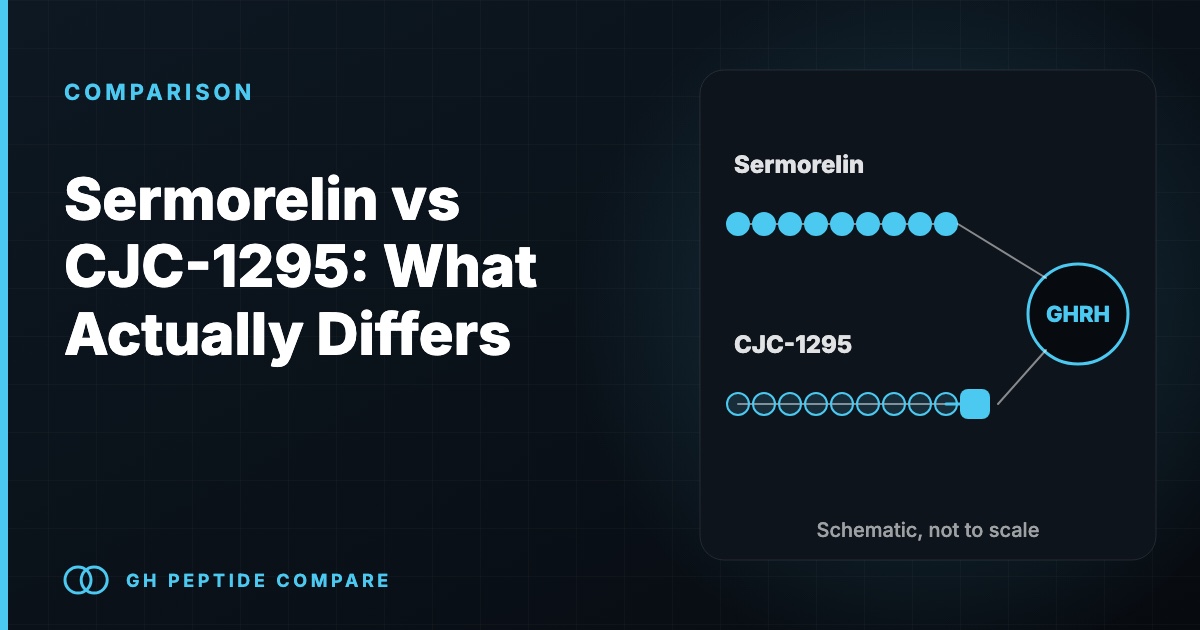
Quick answer: Sermorelin and CJC-1295 are both synthetic analogs of growth-hormone-releasing hormone (GHRH), each built on the first 29 amino acids. They differ in construction, in documented duration, and in regulatory history. Sermorelin had approved brand products that FDA withdrew in 2009; FDA says no form of CJC-1295 is a component of an approved drug and lists safety concerns about it. Whoosh offers compounded sermorelin, which is not FDA-approved, and does not offer CJC-1295.
People often meet these two names on the same clinic menu and assume they are interchangeable. This page sets out what the sources say about each, using the same questions for both. It is a comparison of documents, not a recommendation. For the single-peptide background, see the sermorelin profile and the CJC-1295 and ipamorelin profile.
Sermorelin vs CJC-1295 at a glance
| Question | Sermorelin | CJC-1295 | Source |
|---|---|---|---|
| What is it built from? | A 29 amino acid analogue of human GHRH, as one published review describes it | FDA's briefing calls CJC-1295 free base a synthetic 29 amino acid analogue of GHRH | Prakash and Goa 1999; FDA briefing 2024-12-04 |
| How many versions? | Listed by FDA as sermorelin acetate | FDA counts five bulk substances (free base, acetate and three DAC forms) as two different active moieties | FDA 503B list; FDA briefing |
| Duration in people | No half-life figure confirmed in the sources we read | For the DAC form, a published estimate of 5.8 to 8.1 days in healthy subjects; none found for CJC-1295 without DAC | Teichman 2006 |
| Ever approved by FDA? | Yes, as the brand Geref; approval withdrawn effective 2009-06-18 | FDA says none of the five is a component of an approved drug | Federal Register 2013; FDA briefing |
| FDA 503A list (updated 2026-05-14) | Absent from every category | Absent from every category | FDA 503A list |
| FDA 503B list (updated 2025-03-21) | Category 1; FDA's double-asterisk marker means a component of an approved drug | Does not appear in that file | FDA 503B list |
| Human data | Adult studies of GHRH 1-29 peptides; a pediatric study; no weight-loss trial found | Three studies, all in healthy adults; none in anyone with a disease | PubMed abstracts; FDA briefing |
| Offered by Whoosh? | Yes, compounded, not FDA-approved | No | Whoosh terms |
Table as of 2026-10-06. Every row was re-read from the source on that date.
How each works
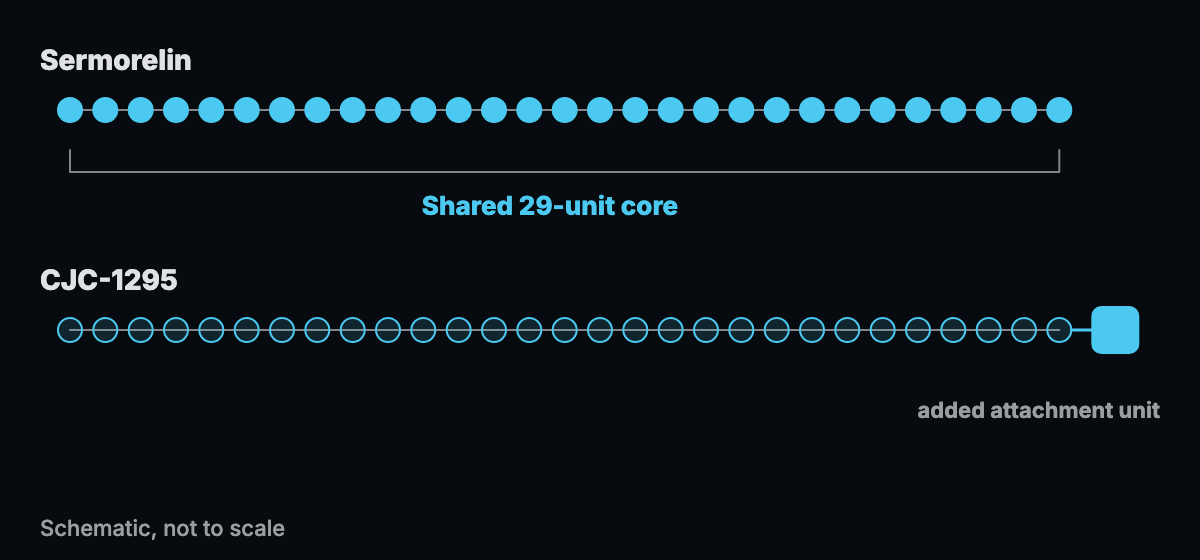
Growth-hormone-releasing hormone is the hormone the hypothalamus uses to signal the pituitary gland. Both peptides here are analogs of the first 29 amino acids of that hormone. As a plain definition, GHRH signals through the GHRH receptor on pituitary cells, so an analog of it is expected to act at the same receptor. None of the sources we opened states that in one sentence for CJC-1295, so this page says "analogue of GHRH" where FDA says it and does not go further.
The practical point is that the shared starting hormone says little about the finished product. Each peptide is a separate molecule with its own chemistry, its own history and its own paper trail. The next section explains why that matters.
Why same-receptor does not mean same product
Two medicines can aim at the same target and still be different products. The sources show this in four ways.
Structure. FDA's briefing for its advisory committee describes CJC-1295 free base as a synthetic 29 amino acid analogue of GHRH. It describes CJC-1295 DAC as the same peptide with an MPA-Lys unit added at the C terminus, and says these are "two different active moieties" across five bulk substances. Sermorelin, by contrast, appears in FDA documents as one named substance. The briefing says ConjuChem made maleimido derivatives of human GHRH 1-29 to address the short half-life of the natural hormone, and that DAC allows bonding with serum albumin in the body. FDA adds that "it has been proposed" this explains a longer half-life, which is a hypothesis in the briefing, not a finding.
Duration. The only half-life figures we could verify are for the DAC form. A 2006 paper by Teichman and colleagues, in two placebo-controlled trials in healthy adults aged 21 to 61, estimated the half-life of CJC-1295 at 5.8 to 8.1 days, with mean GH concentrations raised 2- to 10-fold for six days or more after a single injection. FDA notes that demonstrating a longer half-life for the DAC form than for the form without it "would be needed" to support the idea that DAC drives stability, and we found no human half-life for CJC-1295 without DAC. We found no half-life figure for sermorelin in the sources we opened and have left it out. A reader should be wary of any page that prints a neat duration for each.
FDA's safety statement. On its page about bulk substances that may present significant safety risks, FDA says compounded drugs containing CJC-1295 "may pose risk for immunogenicity for certain routes of administration" and may have complexities with peptide-related impurities and characterization. It adds: "FDA has identified serious adverse events associated with CJC-1295 including increased heart rate and systemic vasodilatory reaction. Available clinical data are limited." The same page does not name sermorelin.
Advisory committee votes. FDA's Pharmacy Compounding Advisory Committee (PCAC) met on 2024-12-04 on whether five CJC-1295 forms should go on the 503A bulks list. The votes against placing them on the list were: CJC-1295 free base, 13 no and 0 yes; CJC-1295 acetate, 12 no and 1 yes; CJC-1295 DAC free base, 13 no and 0 yes; DAC acetate, 13 no and 0 yes; DAC trifluoroacetate, 13 no and 0 yes. The nominations had been withdrawn, and FDA evaluated the substances at its own discretion. These votes are advisory and non-binding; the briefing's proposal was not to add any of the five forms to the list.
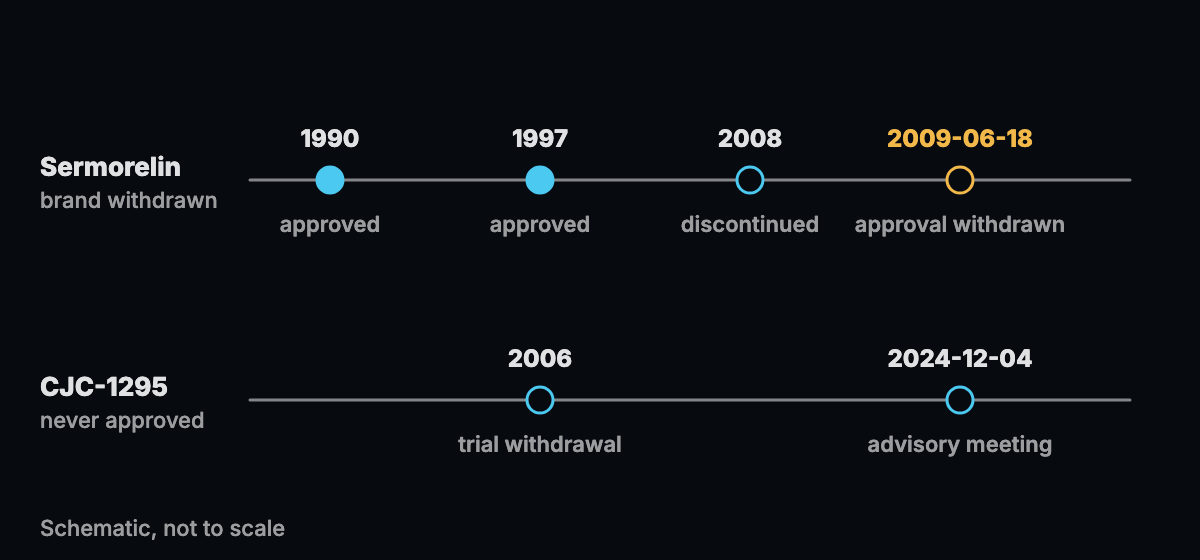
The 2006 trial death. FDA's briefing states: "ConjuChem Biotechnology withdrew CJC-1295 DAC from clinical trials in 2006 after the death of a subject involved in a phase 2 trial." The detail comes from what FDA calls anecdotal reports, two internet articles that are not peer-reviewed. According to those reports, 192 subjects with HIV lipodystrophy were enrolled; two hours after an injection one subject reported chest discomfort and an ECG confirmed an acute myocardial infarction; the subject died about an hour later. The briefing relays that the attending physician's most likely explanation was asymptomatic coronary artery disease with plaque rupture and occlusion, and that the study was terminated with its data unpublished. This page draws no conclusion about cause. The sources we read do not establish one.
What FDA has said about each
Sermorelin. The brand Geref had two FDA applications, both held by EMD Serono: an ampule approved 1990-12-28 for evaluating how well the pituitary secretes GH, and vials approved 1997-09-26 for children with growth failure from idiopathic GH deficiency. The maker notified FDA of discontinuation in 2008, and FDA's withdrawal of approval took effect 2009-06-18. A 2013 Federal Register notice says the products "were not withdrawn from sale for reasons of safety or effectiveness." That is a technical determination about generic applications, not an endorsement. The full timeline is on is sermorelin FDA-approved.
CJC-1295. FDA's briefing says none of the substances is a component of an approved drug and that "there are no data on effectiveness for any of the substances evaluated" for growth hormone deficiency. It also reports the marketing: CJC-1295 "is marketed online for weight loss and muscle building as well as an anti-aging peptide."
What the human evidence is
For sermorelin, the adult studies used GHRH 1-29 peptides rather than a product named sermorelin in the abstracts. Khorram and colleagues (1997) gave 19 adults aged 55 to 71 an analog, [Nle27]GHRH-(1-29)-NH2, for 16 weeks after four weeks of placebo; nocturnal GH rose, body weight was unaffected and lean body mass rose in men only. Vittone and colleagues (1997) studied 11 men aged 64 to 76 for six weeks and reported no change in IGF-I, weight or scan-measured muscle and fat. In children, a multicenter study of GHRH-(1-29) in 110 previously untreated GH-deficient children reported a good response at six months in 74 percent of those analyzed.
For CJC-1295, FDA found three published studies, all in healthy adults, with 63 people in total, 87 percent of them men. No study gave any form of CJC-1295 to people with a disease. Adverse events in healthy subjects included injection-site reactions, headache, flushing and transient low blood pressure.
| Claim as marketed | Who says it | What supports it | Grade |
|---|---|---|---|
| CJC-1295 stays active for days | Clinic and vendor pages, per FDA's description of marketing | Teichman 2006 estimated a half-life of 5.8 to 8.1 days for the DAC form in healthy subjects | STUDIED IN HUMANS |
| CJC-1295 supports weight loss and muscle building | Online sellers, as FDA reports | FDA found no data on effectiveness; studies were in healthy adults | NO PUBLISHED DATA |
| Sermorelin raises growth hormone in older adults | Clinic pages | Small GHRH 1-29 studies: nocturnal GH rose in both; IGF-I rose in one and not the other | STUDIED IN HUMANS |
| Sermorelin once had an approved brand | Clinic pages | Federal Register notice on Geref; approval withdrawn 2009-06-18 | APPROVED LABEL |
| CJC-1295 has a clean safety record | Vendor pages | FDA cites serious adverse events and limited data | STUDIED IN HUMANS |
Safety statements as reported
Geref's label could not be found in any database we tried, so no label warnings appear here. In a published review of sermorelin given to children, the most common adverse events were transient facial flushing and injection-site pain. Khorram's 16-week adult study reported transient hyperlipidemia as the only adverse side effect, and Vittone's reported no significant adverse effects.
For CJC-1295, FDA's briefing lists adverse events from the healthy-subject studies: injection-site reactions, systemic vasodilatory reactions, headache, nausea, abdominal pain, diarrhea, transient involuntary leg muscle contractions, dizziness, low blood pressure and a faster heart rate. It adds that "compounded drugs do not include labeling that would adequately warn physicians and patients of such risks," and that the long-term safety profile in humans is unknown. See also sermorelin side effects.
Who offers what
Whoosh offers compounded sermorelin, which is not FDA-approved; read the Whoosh Wellness sermorelin review for what Whoosh says about it. Whoosh does not offer CJC-1295. As stated by Whoosh, read 2026-10-06, a licensed physician reviews each intake, and a licensed physician decides whether a prescription is appropriate. We print no price because Whoosh's own pages disagree.
Which question are you asking?
| Situation | What the sources say | Page to read |
|---|---|---|
| A clinic pitched CJC-1295 as an upgrade to sermorelin | The two share a starting hormone but differ in construction, history and FDA statements | This page |
| Which of them did FDA ever approve? | Only sermorelin, as Geref, and that approval was withdrawn in 2009 | Is sermorelin FDA-approved? |
| I saw CJC-1295 mixed with ipamorelin | A blend is a third thing; evidence for one part does not carry over | CJC-1295 and ipamorelin vs sermorelin |
| I want three peptides in one table | The sourced table covers sermorelin, tesamorelin and ipamorelin | Three-way table |
| I want questions to bring to a prescriber | A one-page list covers source, status and monitoring | Checklist |
FAQ
Is CJC-1295 the same as sermorelin?
No. Both are analogs of the first 29 amino acids of GHRH, but FDA's briefing describes CJC-1295 as five bulk substances across two active moieties, while sermorelin appears as one named substance with its own approval history.
What does DAC mean?
DAC stands for drug affinity complex. FDA's briefing describes CJC-1295 DAC as CJC-1295 with an MPA-Lys unit added at the C terminus, which it says allows bonding with serum albumin.
Did a person die in a CJC-1295 trial?
FDA's briefing says ConjuChem withdrew CJC-1295 DAC from clinical trials in 2006 after the death of a subject in a phase 2 trial. The detail rests on unreviewed anecdotal reports, and the briefing relays a physician's explanation involving coronary artery disease. The sources do not establish a cause.
Is CJC-1295 FDA-approved?
No. FDA's briefing says none of the CJC-1295 substances is a component of an FDA-approved drug.
Was sermorelin removed because it was unsafe?
The 2013 Federal Register notice says Geref was not withdrawn from sale for reasons of safety or effectiveness. That is a determination about the discontinued brand, not an endorsement of compounded versions, which are not FDA-approved.
Can I get CJC-1295 through Whoosh?
No. Whoosh does not offer CJC-1295.
Sources
- Prakash and Goa, BioDrugs 1999 (PubMed 18031173) read 2026-10-06
- FDA PCAC briefing on CJC-1295, 2024-12-04 read 2026-10-06
- FDA PCAC final summary minutes, 2024-12-04 read 2026-10-06
- FDA: bulk substances that may present significant safety risks read 2026-10-06
- FDA 503A category list, updated 2026-05-14 read 2026-10-06
- FDA 503B category list, updated 2025-03-21 read 2026-10-06
- Federal Register 78 FR 14095, 2013-03-04 read 2026-10-06
- Teichman et al. 2006 (PubMed 16352683) read 2026-10-06
- Khorram et al. 1997 (PubMed 9141536) read 2026-10-06
- Vittone et al. 1997 (PubMed 9005976) read 2026-10-06
- Thorner et al. 1996 (PubMed 8772599) read 2026-10-06
- Whoosh Wellness terms read 2026-10-06
Not medical advice. See the medical disclaimer.